It does not serve my beloved Mormon Church well to have Glen Beck as currently its most prominent member. The guy fosters hatred and fear and turns it all into personal profit and career advancement.
And it is odd, to say the least, to see him try to adopt the Civil Rights Movement as his own, while at the same time pushing the loathsome political ideas of Cleon Skouson and a young Ezra Taft Benson -- both of whom denounced the Civil Rights Movement as a "communist conspiracy." Beck sees himself as the new Martin Luther King. Too bad he is in love with people who hated everything MLK stood for.
Tuesday, August 31, 2010

Life's little pleasures [Bryan]
I listed some overrated things a few weeks ago. Now let me list some of my life's little pleasures:
1. I love drinking cool water from a garden hose on a hot summer day.
2. I love the moment when the alarm goes off, but you then suddenly realize you don't need to get up. (I actually used to set my alarm on Saturdays so I could wake up with normal dread and then feel the joyous sensation that came with remembering I didn't need to get up for two more hours.)
3. I love peeling off the protective tape after I've painted a room to reveal all the clean edges.
4. I love nose kisses from Nora.
5. I love new, fluffy towels. (We recently bought new towels after using our old ones for 12 years -- they were like sandpaper.)
6. I love finally swatting a fly after missing it ten straight times and then screaming in triumph as man conquers nature.
7. I love the moment, at the end of a workout, when you realize you can finally, gasp, stop exercising for the day.
8. I love the feel of a fish taking my fly.
9. I love coming home and hearing Stephen yell "Daddy!" in delight.
10. I love making neat patterns in the grass as I mow the lawn. My favorite: diagonal slashes across the front lawn.
1. I love drinking cool water from a garden hose on a hot summer day.
2. I love the moment when the alarm goes off, but you then suddenly realize you don't need to get up. (I actually used to set my alarm on Saturdays so I could wake up with normal dread and then feel the joyous sensation that came with remembering I didn't need to get up for two more hours.)
3. I love peeling off the protective tape after I've painted a room to reveal all the clean edges.
4. I love nose kisses from Nora.
5. I love new, fluffy towels. (We recently bought new towels after using our old ones for 12 years -- they were like sandpaper.)
6. I love finally swatting a fly after missing it ten straight times and then screaming in triumph as man conquers nature.
7. I love the moment, at the end of a workout, when you realize you can finally, gasp, stop exercising for the day.
8. I love the feel of a fish taking my fly.
9. I love coming home and hearing Stephen yell "Daddy!" in delight.
10. I love making neat patterns in the grass as I mow the lawn. My favorite: diagonal slashes across the front lawn.
Wednesday, August 25, 2010
Trip to Glacier [Bryan]

We returned Sunday from a long trip back to Utah and, for me, a trip backpacking in Glacier National Park. It would be impossible to tell you about all our adventures (and misadventures). I will let Ellie write, if she wants, about how the children suffered a Grade-A, first class meltdown while I was away in the wilderness for seven days, complete with vomiting, fevers, sobbing, staff infections, and all manner of uncontrolled bodily fluids. Overall, though, we were overwhelmed by how welcoming and generous everybody was who shared their time, homes, and food with us, a strange family from Ohio. Highlights included bike rides, eating, swimming, eating, hiking, eating, museums, eating, and getting to know better family and friends.
Now, Glacier was beautiful in a way that is hard to describe. Many of you know that I've been backpacking with my brother and uncle for over twenty years. We've explored many of the great mountain ranges of the West, including the Tetons, Wind Rivers, Sawtooths, Rubies, Uintahs, and so forth. This year we scheduled a trip to the Many Glacier section of Glacier on the east side of the park, a place none of us had ever been.
Overall, we were on the trail 4 days and covered a respectable 37 miles. Glacier is an interesting place in that it felt more alive than most of the other National Parks I've visited. We saw, up close, plenty of big horn sheep, mountain goats, deer, and moose, along with furry little critters of all shapes and sizes. We heard wolves howling at night and, although we didn't see any bears, their presence was obvious from reports of others along the trail, manifestations of bear poop, and so forth. We were armed to the teeth with bear spray and took all sorts of precautions (including hanging our toothbrushes along with our food). We camped at 3 campsites, each more spectacular than the last. Our last night, we camped at Helen Lake, a beautiful green glacier lake surrounded by towering cliffs, multiple waterfalls, and distant mountain peaks. I don't think it is inappropriate to call such a place "sacred."
One of the great things about backpacking is, ironically, how horrifically terrible it is. I won't lie, some of the ascents (including a 2500 foot climb up to Ptarmigan tunnel) kicked my butt, big time. I could barely put one foot in front of the other, and cursed the day I decided it would be fun to strap a 40 lbs pack on my back and go march around the wilderness. The hardness, though, makes is satisfying in a deeply fulfilling way. At the end of the ascent, as you conquer a hill, approach an incredible vista, or simply realize you've survived, you find that there is something strong inside you, something inside you that is worthy of admiration. And the scenery always makes everything worth it. Fishing was good, too.
I don't have any of my own pictures yet. I actually used something called "film" that is being "developed." I stole a few off my brother's Facebook page, though, and here they are (until he calls his lawyers).
 Here we are at Ptarmigan Tunnel after climbing 2500 feet.
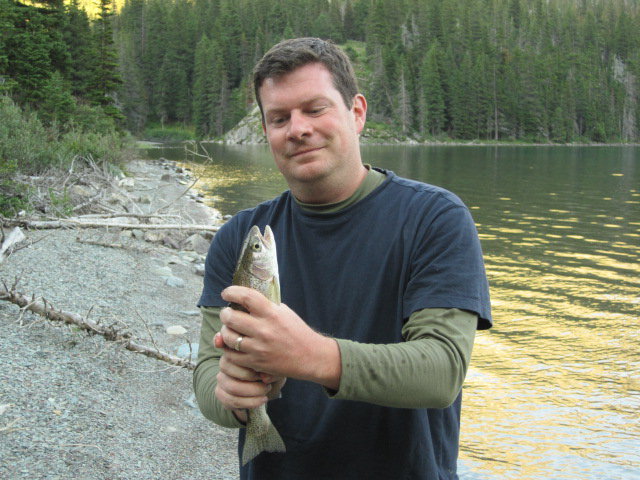 Nice, fat 14 inch Rainbow.
 At Red Gap Pass -- Mountain peaks surrounding us in every direction.
 Derek at Helen Lake
Monday, August 02, 2010
Overrated things [Bryan]
1. Thick milkshakes are overrated. You should be able to drink a milkshake with a straw.
2. Making your bed is overrated. You are just going to mess it up again in 12 hours. (Sorry Mom!)
3. The Sunday comics are overrated. They are almost never funny.
4. Things that are "organic" are overrated. I love buying fresh and local, but "organic" has almost no meaning.
5. Coming to a complete stop is overrated. You can almost always adequately survey an intersection rolling slowly.
6. Flossing is overrated. A dentist told me he can't usually tell if someone flosses by looking at their teeth. And he told me that most dentist don't floss regularly, either.
7. Breakfast is overrated. I like pancakes as much as the next guy, but the food traditionally served at breakfast is uninspiring and dull.
8. Fertilizer that claims to prevent crabgrass is overrated. Never seems to work.
9. The United State Senate is overrated. The rules of the Senate seem designed to thwart democratic accountability and reward egoistic grandstanding.
10. Bacon on hamburgers is overrated. Doesn't add much except fat and calories.
2. Making your bed is overrated. You are just going to mess it up again in 12 hours. (Sorry Mom!)
3. The Sunday comics are overrated. They are almost never funny.
4. Things that are "organic" are overrated. I love buying fresh and local, but "organic" has almost no meaning.
5. Coming to a complete stop is overrated. You can almost always adequately survey an intersection rolling slowly.
6. Flossing is overrated. A dentist told me he can't usually tell if someone flosses by looking at their teeth. And he told me that most dentist don't floss regularly, either.
7. Breakfast is overrated. I like pancakes as much as the next guy, but the food traditionally served at breakfast is uninspiring and dull.
8. Fertilizer that claims to prevent crabgrass is overrated. Never seems to work.
9. The United State Senate is overrated. The rules of the Senate seem designed to thwart democratic accountability and reward egoistic grandstanding.
10. Bacon on hamburgers is overrated. Doesn't add much except fat and calories.
Saturday, July 31, 2010
Review of Inception [Bryan]
 [Spoiler alert! Don't read this if you plan on seeing the film.]
Ellie and I went to see Inception last night. It was great fun, a really imaginative film, a wild and dark ride. Of course, half of the time I wasn't sure what was going on or why, whose dream we were in, and what the rules were governing the dream world. I'm not sure the logic of the world made sense, but I suppose that is to be expected.
What interested me most was the idea of a "totem," an object that the characters use to determine whether they are dreaming or whether they are awake. The main character, for example, uses a top that he spins whenever he needs to distinguish his dreams from reality. In his dreams, apparently, the top never falls over; it just keeps on spinning. Why he can't simply dream of his top falling over is never explained.
In philosophy, finding a "totem" is the Holy Grail of intellectual achievements, although no one calls it that. The "totem" is a criterion that helps us distinguish between reality and fantasy, between the world as it is and what the mind creates. How can we know for sure that we are not dreaming? How can we distinguish the world "out there" from our biases, wishes, and fantasies? Many philosophers have tried to create such a totem. Indeed, one might say that scientific method is really just one big "totem" that attempts to do precisely this -- distinguish the "real world" from our mind's creations.
[At this point, a real philosopher would give you a long discourse on Immanuel Kant, who argued that concepts like time and space were really just creations of the mind, but I will spare you that particular lecture.]
The film calls into serious question the idea of a totem. Remember, no justification is given for why the totem works as it does; it is something the characters simply assume. Of course, I wanted to shout, you could dream of a top falling over -- why not? But I came to realize that the failure of the totem is precisely the point. At the end of the movie, the hero seems to make his final break with his fantasy world, but the ambiguous ending alerts us to the possibility that no break has been made, and that he may have simply moved from one fantasy to the other. In the last moments, the hero gives up on the idea of his totem: he has found a reality he desires and, as he rushes to his children, does not wait to see if the top falls or if it continues spinning. He has either (a) given up on his totem or (b) he no longer cares about distinguishing fantasy from reality.
So, obviously, the question of the film is whether we can ever find a totem, that is, whether we can ever distinguish reality from our dreams and mental creations. But it also questions whether we should want to find such a thing: Do we not need our fantasies, myths, and dream creations? Could we ever survive without them? The film seems to say no and in that sense, it echoes the philosophy known as Pragmatism, which basically posits that no totem is possible, that human beings construct a world to serve their interests, and that we should judge our discoveries not by how they relate to an unknowable truth but by how they serve human interests. We should embrace our dreams if our dreams can survive the test of human life.
There is a lot to be said for that position. But I guess I still cling to my totems as a matter of faith. Perhaps, for me, the idea of a totem, of being able to distinguish the real from the imagined, is precisely the fantasy I need to believe in.
Friday, July 30, 2010
Origin of the phrase "hue and cry" [Bryan]
Some people have asked me where the phrase "hue and cry" comes from. The Columbia Encyclopedia says:
The "hue and cry," formerly, in English law, is the pursuit of a criminal immediately after he had committed a felony. Whoever witnessed or discovered the crime was required to raise the hue and cry against the perpetrator (e.g., call out "Stop, thief !") and to begin pursuit; all persons within hearing were under the same obligation, and it was a punishable offense not to join in the chase and capture. The perpetrator was promptly brought into court, and if there was evidence of his having been caught red-handed, he was summarily convicted without being allowed to testify in his own behalf. The hue and cry was abolished in the early 19th cent. Possible modern survivals are the obligation to serve on a sheriff's posse and to assist a police officer in pursuing a suspected culprit.So, there you have it. What this has to do with our family, I have no idea, other than it is a phrase suggesting clamor and chaos. I thought it would be a fun name for a blog. At the very least, it is much better than the name of YOUR blog.
Wednesday, July 21, 2010
Trip to Pennsylvania
We spent last weekend in our neighboring state of Pennsylvania. Activities included visiting the interesting town of Hersey ("the sweetest place of earth"), hanging out with Ellie's brother Sam and wife Emily (who live in Allentown), and touring the historic district of Philadelphia. Pictures below:
 Stephen ready for adventure.
 Nora and Andrew at the Hersey amusement park. The scale of rides was only matched by the scale of the crowds.
 Here, Andrew is able to combine his two passions in life -- candy and cars.
 At the Hersey "World of Chocolate" tour.
 Independence Hall.
 Here is a bell of some sort. Not a good one. There is a crack is on the other side.
 Sam is interning for Air Products -- the biggest company you've probably never heard of. Very impressive operation they have going there -- even a waterfall!
 We finished with a Philly steak sandwich at Jim's Steaks. Yummy.
 Here are our intrepid and patient hosts. Thanks Sam and Emily for treating us so well!
 Stephen ready for adventure.
 Nora and Andrew at the Hersey amusement park. The scale of rides was only matched by the scale of the crowds.
 Here, Andrew is able to combine his two passions in life -- candy and cars.
 At the Hersey "World of Chocolate" tour.
 Independence Hall.
 Here is a bell of some sort. Not a good one. There is a crack is on the other side.
 Sam is interning for Air Products -- the biggest company you've probably never heard of. Very impressive operation they have going there -- even a waterfall!
 We finished with a Philly steak sandwich at Jim's Steaks. Yummy.
 Here are our intrepid and patient hosts. Thanks Sam and Emily for treating us so well!
Some consistency, please -- UPDATED with new chart [Bryan]
The next time people start complaining about the budget deficit, ask them whether they support the extension of President Bush's 2001 tax cuts for wealthy Americans. If they say yes, something is obviously amiss in their reasoning. As you can see below, nothing has increased the deficit over the past years more than Bush's tax cuts . Strange how, for some people, we can't afford to help the unemployed or to help states retain school teachers, but we can always afford wars and tax breaks for the wealthy.
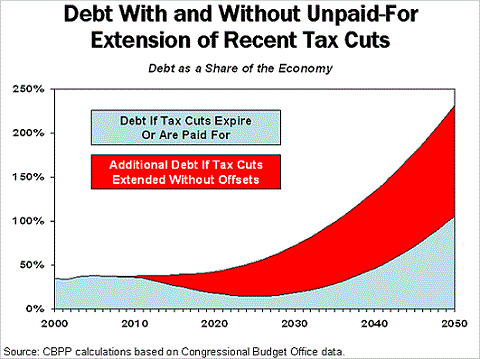
 I'm not saying all of the Bush-era tax cuts are necessarily bad, or that they should not be temporarily renewed during this recession. I'm just pointing out the inconsistency of championing both deficit reduction and the extension of massive tax cuts.
Meanwhile, Obama signed into law the Wall Street reform bill today. This brings the list of his legislative accomplishments to: Wall Street reform, health care reform, stimulus package (too small, it turns out, but still very important), the much-needed overall of the student-loan system, the Lily Ledbetter Fair Pay Act, new credit card industry regulation, a national service bill, expanded stem-cell research, and the land-protection act. Not bad, not bad at all. Of course, if we don't get more jobs soon, nobody will care.
I'm not saying all of the Bush-era tax cuts are necessarily bad, or that they should not be temporarily renewed during this recession. I'm just pointing out the inconsistency of championing both deficit reduction and the extension of massive tax cuts.Meanwhile, Obama signed into law the Wall Street reform bill today. This brings the list of his legislative accomplishments to: Wall Street reform, health care reform, stimulus package (too small, it turns out, but still very important), the much-needed overall of the student-loan system, the Lily Ledbetter Fair Pay Act, new credit card industry regulation, a national service bill, expanded stem-cell research, and the land-protection act. Not bad, not bad at all. Of course, if we don't get more jobs soon, nobody will care.
Wednesday, July 14, 2010
Calling Doctor Scott [Bryan]
When we arrived in Columbus, we needed some quick medical care and we looked up the closest family doctor we could find. We found one, a male doctor in his fifties, a few miles from our house in a rundown part of town. He works out of a grungy basement practice, which serves, as far as we can tell, mostly lower-income, Medicaid patients. Since then, we have been too lazy to change our provider, and have stuck with this fellow. On the plus side, this doctor has not qualms about bending the rules for our benefit. "Now, I can't tell you that your wife can take some of the medicine from this extra-large bottle of pink eye medication I just prescribed," he will say with a wink. "It would be against the rules," he will repeat, "so I can't tell you to share it when she comes down with it, as she will." Of course, I would then share, thus saving us money and an extra trip to the doctor. A doctor who cares more about patients than rules is a valuable thing.
On the downside, this doctor reminds us both of the Michael Scott character from The Office. He is loud and obnoxious, with an hugely inflated sense of his own sense of humor. He can be heard shouting things to his nurses down the hall that border on impropriety. Every once in awhile, I have to stop and think, "Did he really just say what I thought he said?" Not an office visit goes by without us coming home with new stories of our doctor's antics.
I'm thinking we might change soon. Or not.

On the downside, this doctor reminds us both of the Michael Scott character from The Office. He is loud and obnoxious, with an hugely inflated sense of his own sense of humor. He can be heard shouting things to his nurses down the hall that border on impropriety. Every once in awhile, I have to stop and think, "Did he really just say what I thought he said?" Not an office visit goes by without us coming home with new stories of our doctor's antics.
I'm thinking we might change soon. Or not.
Sunday, July 04, 2010
Well, how was it? [Bryan]
If you are a guest at somebody's house, and you like the food, you really should say so. Unless you didn't like it, I suppose. Or, unless you ate so much that your actions speak louder than any words. Otherwise, you should always praise the food. The less you eat, the more praise you need to give. Also, don't assume that the woman has done all the cooking!
Just had to get that off my chest.
Just had to get that off my chest.
Thursday, July 01, 2010
Appreciating the BOM [Bryan]
I have a strange relationship with the Book of Mormon (BOM). It has been one of the most important books in my life, a book I consider to be a sacred text. And yet, I have sometimes felt uncomfortable, even a little ashamed, of some aspects of it. It really is a strange book, sometimes awkwardly written, full of seemingly simplistic didactic moral tales ("be good and God will protect and reward you"). Its picture of human life, where angels constantly visit people and where the good prosper while the wicked are justly punished, often doesn't square with life as I experience it.
Enter Grant Hardy's new book, Understanding the Book of Mormon: A Reader's Guide (Oxford University Press, 2010). This book has given me a renewed appreciate for the literary qualities of the BOM. Hardy's idea is that we should focus more on the three major internal editors: Nephi, Mormon, and Moroni. If we do this, the literary complexity of the book emerges. What has impressed me most about Hardy's work is that it has allowed the BOM to better speak to life as I understand it.
Consider the following example. The major editor of the book, Mormon, presents himself as a historian who uses history to teach moral and religious lessons. Now, in my experience, it is often very difficult to draw lessons from the past. There are always holes in the stories we want to tell, exceptions to the lessons we want to draw. Often, history shows that the distinction between "good guys" and "bad guys" gets blurry and that human success is always intermingled and often inseparable from human failure.
Mormon, for his part, wants to teach us a lesson that wicked people meet a bad end. To make this point, however, Hardy shows how Mormon has to edit out certain events that don't seem to fit his moral story. Take one example, of many. The people of Ammonihah are portrayed as some of the greatest villains of the BOM -- their biggest crime is burning innocent women and children in a orgy of religious bigotry. This evil people eventually meet their just end as their city is conquered and annihilated by a Lamanite army. This all supports Mormon's thesis: bad guys meet a bad end. The problem is, though, that other people were conquered by the Lamanite army at that time, as well, as Mormon briefly notes. "Some around the borders of Noah," he notes, were also killed (see Alma 16:3) What about these people? Did they deserve it, too? Later, we hear only that they were strategically "weak." Nothing is said about this city being particularly wicked. If they were wicked, presumably Mormon would have told us since this data could have been used to support his point. The reality, it seems, was a bit more messy than his simple lesson would admit. Hardy shows us many examples like this of how there exists a complex reality behind the lessons the BOM editors want to teach. They are trying to construct a comprehensible story in the face of a complex reality that sometimes escapes their finite human understanding. As Paul says, we all see through a glass, darkly.
This realization about the BOM editors made me feel a closer connection to the book and its very human (and now more true-to-real-life) characters. The world that exists behind the scenes of the BOM matches more closely the murky world as I experience it. The editorial lessons are helpful, inspired, and true, but these glimpses of the underlying complexity open the door for continued searching, continued meditation, continued grasping for greater light and knowledge. In this sense, the Book of Mormon invites us to enter a world, not only of eternal truths, but also of continued questions; a world not only of inspired words, but also of a need for personal inspiration; a world not only full of simple moral tales, but also full of the tragic richness of human life.
Enter Grant Hardy's new book, Understanding the Book of Mormon: A Reader's Guide (Oxford University Press, 2010). This book has given me a renewed appreciate for the literary qualities of the BOM. Hardy's idea is that we should focus more on the three major internal editors: Nephi, Mormon, and Moroni. If we do this, the literary complexity of the book emerges. What has impressed me most about Hardy's work is that it has allowed the BOM to better speak to life as I understand it.
Consider the following example. The major editor of the book, Mormon, presents himself as a historian who uses history to teach moral and religious lessons. Now, in my experience, it is often very difficult to draw lessons from the past. There are always holes in the stories we want to tell, exceptions to the lessons we want to draw. Often, history shows that the distinction between "good guys" and "bad guys" gets blurry and that human success is always intermingled and often inseparable from human failure.
Mormon, for his part, wants to teach us a lesson that wicked people meet a bad end. To make this point, however, Hardy shows how Mormon has to edit out certain events that don't seem to fit his moral story. Take one example, of many. The people of Ammonihah are portrayed as some of the greatest villains of the BOM -- their biggest crime is burning innocent women and children in a orgy of religious bigotry. This evil people eventually meet their just end as their city is conquered and annihilated by a Lamanite army. This all supports Mormon's thesis: bad guys meet a bad end. The problem is, though, that other people were conquered by the Lamanite army at that time, as well, as Mormon briefly notes. "Some around the borders of Noah," he notes, were also killed (see Alma 16:3) What about these people? Did they deserve it, too? Later, we hear only that they were strategically "weak." Nothing is said about this city being particularly wicked. If they were wicked, presumably Mormon would have told us since this data could have been used to support his point. The reality, it seems, was a bit more messy than his simple lesson would admit. Hardy shows us many examples like this of how there exists a complex reality behind the lessons the BOM editors want to teach. They are trying to construct a comprehensible story in the face of a complex reality that sometimes escapes their finite human understanding. As Paul says, we all see through a glass, darkly.
This realization about the BOM editors made me feel a closer connection to the book and its very human (and now more true-to-real-life) characters. The world that exists behind the scenes of the BOM matches more closely the murky world as I experience it. The editorial lessons are helpful, inspired, and true, but these glimpses of the underlying complexity open the door for continued searching, continued meditation, continued grasping for greater light and knowledge. In this sense, the Book of Mormon invites us to enter a world, not only of eternal truths, but also of continued questions; a world not only of inspired words, but also of a need for personal inspiration; a world not only full of simple moral tales, but also full of the tragic richness of human life.
Wednesday, June 30, 2010
Salt Lake City reborn [Bryan]
When I was a student at the University of Utah, I had an art professor who always talked about a great urban tragedy. The tragedy was the Salt Lake City had taken most of its beautiful mountain streams and channeled them into pipes underground. He had this idea of letting the rivers flow more freely through the valley. It would, he argued, create that waterfront ambiance that most great cities have (think Paris, London, Chicago, etc.). I came to agree with him. In that context, I was excited to see that the "City Creek" project, which involves letting that river emerge from underground, is becoming a reality. Salt Lake is becoming one cool city. Check out this tour of new downtown development project:
Sunday, June 20, 2010
Bad day on the hill - updated [Bryan]
Today, 42 senators will filibuster the so-called "tax-extenders" bill. The bill would extend unemployment benefits, would protect doctors from a 21 percent pay cut for Medicare patients, would close tax loopholes for companies that move jobs overseas, and would provide billions in aid to state governments. Without the aid to states alone, there will be 900,000 public- and private-sector layoffs, mostly teachers, police officers, and fire fighters. The cuts to unemployment benefits will reduce demand in the economy, thereby making more businesses cut back on hiring. The Republicans, who were fine with running huge budget deficits during the Bush years, won't even let this bill come up from a vote. If you are a looking for moment when the U.S. economic recovery died, this could be it.
Reminds me of a story. Once upon a time, in 1937, a country was on the verge of coming out of the Great Depression. The country had spent a lot of money of programs designed to improve unemployment and, because of this, it was running big budget deficits. Employment was slowly improving and economic growth was returning. All the politicians, however, including a president named FDR, started to feel guilty about all that spending and decided to prove how tough and fiscally virtuous they were by cutting the budget, raising taxes, and tightening the monetary supply. The result was four more years of depression and continued human suffering. Read about the "Roosevelt Recession" here.
We seem to be going down this same path again. This is bad news.
Update: Yup, conservatives blocked the bill from even coming up for a vote. Apparently, it only takes 42 out of 100 senators to bring an economic recovery to its knees. I should point out that Harry Reid cut the spending on this bill in half, and cut the deficit spending to a quarter of what was originally proposed. All in a vain effort to compromise with people who simply will not compromise on anything.
Reminds me of a story. Once upon a time, in 1937, a country was on the verge of coming out of the Great Depression. The country had spent a lot of money of programs designed to improve unemployment and, because of this, it was running big budget deficits. Employment was slowly improving and economic growth was returning. All the politicians, however, including a president named FDR, started to feel guilty about all that spending and decided to prove how tough and fiscally virtuous they were by cutting the budget, raising taxes, and tightening the monetary supply. The result was four more years of depression and continued human suffering. Read about the "Roosevelt Recession" here.
We seem to be going down this same path again. This is bad news.
Update: Yup, conservatives blocked the bill from even coming up for a vote. Apparently, it only takes 42 out of 100 senators to bring an economic recovery to its knees. I should point out that Harry Reid cut the spending on this bill in half, and cut the deficit spending to a quarter of what was originally proposed. All in a vain effort to compromise with people who simply will not compromise on anything.
Saturday, June 19, 2010
Tales of a stay-at-home dad [Bryan]
I just finished with three days of being a single, stay-at-home father. Whew! I escaped with my sanity (barely) and a renewed appreciation for Ellie. I also enjoyed spending the time with my kids, particularly talking to them and getting a glimpse of the thoughts that rumble around in their little minds. Take the following instance, when I was stalking a fly with a fly swatter.
Nora: Daddy, don't kill that fly.Fascinating stuff.
Dad: Huh?
Nora: You shouldn't kill any animals unless you have to. You should catch it and let it go.
Dad: It's just a fly.
Nora: It is still something that is alive.
Dad: Why do you think it is wrong to kill things that are alive?
Nora: Because nature is important. It is even more important than television. And ice cream.
Monday, June 14, 2010
Perfect cookies - Updated [Bryan]
My quest for the perfect mashed potatoes has been well-documented on this blog. Less known is my obsession with finding the perfect chocolate chip cookie recipe. I thought I had found it in the New York Time's Jacques Torres cookie. I have recently uncovered a recipe from America's Test Kitchen (the best source of recipes ever) that might just give it a run for its money. The secret to this recipe seems to be browning the butter and adding dark brown sugar. I'm worried that the salt content is too low (chocolate chip cookies need a salty overtone) and that there is no time for chilling, but we'll see. I'm trying them tonight for Family Night. I will let everyone know how they turn out.
RESULTS: The America's Test Kitchen recipe did indeed make yummy cookies. In fact, the dough was probably the best testing dough I have ever sampled, with deep caramel and toffee flavors. Still, something was lost during the baking process and those flavors didn't come out as strongly in the finished cookie. Further, the taste was not as sophisticated as the New York Times cookie and I think the coarse sea salt in that recipe creates a complexity of flavor that the Test Kitchen cookie does not match. Edge: New York Times.
RESULTS: The America's Test Kitchen recipe did indeed make yummy cookies. In fact, the dough was probably the best testing dough I have ever sampled, with deep caramel and toffee flavors. Still, something was lost during the baking process and those flavors didn't come out as strongly in the finished cookie. Further, the taste was not as sophisticated as the New York Times cookie and I think the coarse sea salt in that recipe creates a complexity of flavor that the Test Kitchen cookie does not match. Edge: New York Times.
Sunday, June 13, 2010
Some recent pictures and videos [Bryan]
It has been too long since I posted some pictures of the family. We've been very busy lately, with Nora in soccer, dance, and piano lessons, Andrew in soccer and gymnastics lessons, and Stephen in walking and talking lessons. As you can tell from these pictures and video clips, they are all growing up quickly.
Stephen is walking (finally). This clip also captures one of his favorite games: playing catch with himself.
 Andrew helping me try out my new camera.
 Nora at the Park of Roses.
 Ellie at the Park of Roses.
 Andrew at the park of Roses.
 Nora's dance recital.
 Nora at the Park of Roses again.
Stephen is walking (finally). This clip also captures one of his favorite games: playing catch with himself.
 Andrew helping me try out my new camera.
 Nora at the Park of Roses.
 Ellie at the Park of Roses.
 Andrew at the park of Roses.
 Nora's dance recital.
 Nora at the Park of Roses again.
Cute Stephen footage
Thursday, June 10, 2010
Against engagement rings [Bryan]
I've always thought the custom of engagement rings was odd. Sure, it is good to show special affection for one's bride-to-be. I was happy to buy a ring for Ellie, since I know how much this means for many women. I wanted to show her that she was just as important to me as the other women who received diamond rings from their men. I would do the same thing again. Wouldn't it be better, though, if we all found a better way of expressing this love?
When Ellie and I got married, we were both students trying to pay our way through college. I worked construction during the summer and as a research assistant during school year. I probably made about $7000 dollars a year doing this, while Ellie made about the same, maybe a little more, working at the Utah Children's Museum. Tuition, books, and living expense ate up most of this income. After buying the ring, and paying for the honeymoon, we started our marriage absolutely broke. I doubt we had $50 to our name. This poverty led to some stress and tensions during the first year (including the now famous "ice cream argument") as we tried to make ends meet -- mostly because of that darn ring.
Anyway, let me join with Friedersdorf and urge women everywhere to start a movement against engagement rings:
When Ellie and I got married, we were both students trying to pay our way through college. I worked construction during the summer and as a research assistant during school year. I probably made about $7000 dollars a year doing this, while Ellie made about the same, maybe a little more, working at the Utah Children's Museum. Tuition, books, and living expense ate up most of this income. After buying the ring, and paying for the honeymoon, we started our marriage absolutely broke. I doubt we had $50 to our name. This poverty led to some stress and tensions during the first year (including the now famous "ice cream argument") as we tried to make ends meet -- mostly because of that darn ring.
Anyway, let me join with Friedersdorf and urge women everywhere to start a movement against engagement rings:
But men are the ones who buy the rings? Look, men are ultimately going to buy whatever it is that women want. It's a change in social norms that guys are never going to bring about on our own. Why should women want to end diamond engagement rings? Well first of all, it's your money too, presuming the wedding eventually occurs, and more than that, you're the ones who are silently judged by status conscious people every time they look at the size of your rock -- in other words, either you've got reason to feel bad about what other people think of you, or else you're complicit in a system that makes people with less wealthy fiances feel bad about themselves.It's up to you, ladies. End the madness!
Tuesday, June 08, 2010
Is morality descreasing? [Bryan]
There is much talk these days, particularly at church, about how evil and nasty the world seems to be getting. Hardly a Sunday goes by with warnings from the pulpit about how bad the world is now compared to what it was before. In some narrow ways, I suppose this is true. It is certainly true that the mass media seems more crass. There is also more widespread access to smut and porn than ever before. Sexual mores have changed, probably being more permissive now than before. If you believe, as I do, that morality is related to these sorts of issues, then in that sense things are indeed going downhill.
Overall, though, I don't think it is true that the world is getting worse. The world is a better place now, morally speaking, than it perhaps has ever been.
Many people think that the pre-1960s era was the pinnacle of human morality -- before all that sex, drugs, and rock-and-roll stormed across the world. But it isn't too hard to see that planet earth from 1900-1960 was, in reality, the most depraved time imaginable from a moral perspective. Human beings butchered each other by the millions during the World Wars. They sent each other to gas chambers, dropped poison gas, unleashed fire bombs and nuclear weapons on women and children. There was widespread rape, mass slaughter, and cruelty on a scale the world has never seen before. This alone is enough to prove that the pre-1960s era was hardly the "good old days." 1900-1960 was perhaps the most barbarous period in world history.
Apart from world war and genocide, we should also consider America before the 60s. Black men were being lynched and burned alive, while almost everyone turned a blind eye. We had a brutal system of injustice and apartheid in the American South during the Jim Crow years. Meanwhile, the interests of women and children were routinely ignored. Women were often beaten with impunity. Child abuse (physical, sexual, and mental) was often covered up, and kids were beaten in schools. Workers on strike had their skulls bashed in with the clubs of hired tough guys. We poisoned the air and polluted the water with little fear of retribution. Again, the good old days were really something of a dark time.
What are things like now? Well, true, porn is a problem. Overall, though, it seem to me that we treat each other better than we did before. We protect vulnerable minority populations. We generally take better care of the poor, the elderly, the mentally ill, and children. Families are supported in ways that they never were before. People, even strangers, seem ready to serve in their communities and lend a hand when necessary, and my family and I have directly experienced this generosity. Plus, we are not starting as many wars as usual (see graph). Violent crime is down over the last 20 years. Property crime is down.
Why do I care about this? Well, first, it just seems historically wrong to say that things are getting worse. Second, I believe we commit something of a moral crime (a sin) in failing to recognize the good that is being done in the world. To condemn the world in this way is to show a lack of respect (and love) for our fellow human beings. So we really should stop doing this.
Overall, though, I don't think it is true that the world is getting worse. The world is a better place now, morally speaking, than it perhaps has ever been.
Many people think that the pre-1960s era was the pinnacle of human morality -- before all that sex, drugs, and rock-and-roll stormed across the world. But it isn't too hard to see that planet earth from 1900-1960 was, in reality, the most depraved time imaginable from a moral perspective. Human beings butchered each other by the millions during the World Wars. They sent each other to gas chambers, dropped poison gas, unleashed fire bombs and nuclear weapons on women and children. There was widespread rape, mass slaughter, and cruelty on a scale the world has never seen before. This alone is enough to prove that the pre-1960s era was hardly the "good old days." 1900-1960 was perhaps the most barbarous period in world history.
Apart from world war and genocide, we should also consider America before the 60s. Black men were being lynched and burned alive, while almost everyone turned a blind eye. We had a brutal system of injustice and apartheid in the American South during the Jim Crow years. Meanwhile, the interests of women and children were routinely ignored. Women were often beaten with impunity. Child abuse (physical, sexual, and mental) was often covered up, and kids were beaten in schools. Workers on strike had their skulls bashed in with the clubs of hired tough guys. We poisoned the air and polluted the water with little fear of retribution. Again, the good old days were really something of a dark time.
What are things like now? Well, true, porn is a problem. Overall, though, it seem to me that we treat each other better than we did before. We protect vulnerable minority populations. We generally take better care of the poor, the elderly, the mentally ill, and children. Families are supported in ways that they never were before. People, even strangers, seem ready to serve in their communities and lend a hand when necessary, and my family and I have directly experienced this generosity. Plus, we are not starting as many wars as usual (see graph). Violent crime is down over the last 20 years. Property crime is down.


Why do I care about this? Well, first, it just seems historically wrong to say that things are getting worse. Second, I believe we commit something of a moral crime (a sin) in failing to recognize the good that is being done in the world. To condemn the world in this way is to show a lack of respect (and love) for our fellow human beings. So we really should stop doing this.
Saturday, May 29, 2010
Awesome [Ellie]
As happens every year about this time in a ward as full of students as mine, several good friends of mine are moving out. I've been a little down about this for the last while; that must explain why Bryan, for Mother's Day, got me a little book called The Book of Awesome.
The Book of Awesome is not the kind of thing that I typically read. It's based on a blog where the author collected 1,000 submissions from people across the web of things they find "awesome." The word "awesome" alone pretty much takes it out of the "books I read" category. But, to humor Bryan, and because I needed to ponder me some awesomeness, I've been picking it up from time to time. Most of the things are small, everyday pleasures that we take for granted. I admit that I've enjoyed most of his ideas, although some things he rhapsodizes about I can't quite relate to.
So, with that long intro, I've come up with a few things he left out that I think are awesome.
*Green cement trucks with fancy stenciled designs on their barrels. I don't know if this is just a Columbus thing or what, but I've never seen such decorative construction vehicles. They make me smile every time I see them.
*When a song comes on the radio that fits your mood exactly, inviting you to sing soulfully at the top of your lungs.
*Spotting the first firefly of the season.
*Finding a great new outfit in your own closet.
*The first time you see your child choose to walk with tiny tottering steps instead of crawling. (Shout out to all you moms with late walkers out there!)
*Finding the right tool for the job. Also the right container.
*Ohio birds. Especially the brightly colored ones. From my house I can see cardinals, goldfinches, and blue jays, besides robins, doves, starlings, grackles, red-wing blackbirds, and sparrows. If I drive down the street a ways, I can see turkey vultures and great blue herons. In the metro parks I've seen bluebirds and even a woodpecker with a scarlet head pecking wood! Sorry for the list, but I really love birds.
*When somebody else has replaced the towels/toilet paper roll.
*When a stain on my baby's shirt comes out on the first try.
*Finding a great book, picked at random, from the library. This is awesome because it hardly ever happens.
*When my non-snuggler child comes to me and wants to snuggle.
*Getting the giggles as an adult.
*When we're driving and Bryan reaches over to hold my hand.
Speaking of Bryan, he's promised to blog his own awesome list. Stay tuned.
Got any awesomeness to add?
The Book of Awesome is not the kind of thing that I typically read. It's based on a blog where the author collected 1,000 submissions from people across the web of things they find "awesome." The word "awesome" alone pretty much takes it out of the "books I read" category. But, to humor Bryan, and because I needed to ponder me some awesomeness, I've been picking it up from time to time. Most of the things are small, everyday pleasures that we take for granted. I admit that I've enjoyed most of his ideas, although some things he rhapsodizes about I can't quite relate to.
So, with that long intro, I've come up with a few things he left out that I think are awesome.
*Green cement trucks with fancy stenciled designs on their barrels. I don't know if this is just a Columbus thing or what, but I've never seen such decorative construction vehicles. They make me smile every time I see them.
*When a song comes on the radio that fits your mood exactly, inviting you to sing soulfully at the top of your lungs.
*Spotting the first firefly of the season.
*Finding a great new outfit in your own closet.
*The first time you see your child choose to walk with tiny tottering steps instead of crawling. (Shout out to all you moms with late walkers out there!)
*Finding the right tool for the job. Also the right container.
*Ohio birds. Especially the brightly colored ones. From my house I can see cardinals, goldfinches, and blue jays, besides robins, doves, starlings, grackles, red-wing blackbirds, and sparrows. If I drive down the street a ways, I can see turkey vultures and great blue herons. In the metro parks I've seen bluebirds and even a woodpecker with a scarlet head pecking wood! Sorry for the list, but I really love birds.
*When somebody else has replaced the towels/toilet paper roll.
*When a stain on my baby's shirt comes out on the first try.
*Finding a great book, picked at random, from the library. This is awesome because it hardly ever happens.
*When my non-snuggler child comes to me and wants to snuggle.
*Getting the giggles as an adult.
*When we're driving and Bryan reaches over to hold my hand.
Speaking of Bryan, he's promised to blog his own awesome list. Stay tuned.
Got any awesomeness to add?
Friday, May 21, 2010
The Road [Bryan]
Just got done reading The Road, by Cormac McCarthy, a fascinating and emotionally wrenching book. The story is about a father and son traveling together through post-apocalyptic devastation. McCarthy tries to imagine a world where conditions render hope an absolute impossibility. Everything is dead, nothing grows, and starving humans feed on each other, even their own children. The dim climate, cold and getting colder, is punctuated only by lightening, freezing rain, and gray snow. All that exists is the shell of the former world, burned-out cities, looted stores, and useless technologies. Even memories of the old world are beginning to fade, “the onset of some cold glaucoma dimming away the world.” People live, shivering and wet, through either cannibalism or scavenging an ever-diminishing supply of canned food. There is no reason to believe in anything, especially that life will get any better or that a loving God exists. As one of the characters says, "People were always getting ready for tomorrow. Tomorrow wasnt getting ready for them. It didnt even know they were there... There is no God and we are his prophets." There is no looking to the future or, as the book says, “There is no later. This is later.”
The central questions this raised for me are these: Would we still have reasons to live in such a world? If everything else were taken away, even the possibility of happiness, what would make life worthwhile? Is there anything to stop us from committing suicide in such a world?
This unsentimental book seems to find at least a fleeting meaning and beauty in the relationships we have with one another. The relationship between father and son, simple and unadorned, is one of the most touching descriptions of familial love I have read. The father desperately tries to encourage his son to live and go on, even while he himself is without hope, and dying. He tries to preserve the kindness and generosity he finds in his son, while enduring the compromises he himself must make with morality to help them survive. You desperately begin to want to take care of this little boy, the lone spark of goodness (the "fire") in a murderous world. The end of the book, where the son asks his Dad to let them die together, is very sad, but profound:
I want to be with you.
You cant.
Please.
You cant. You have to carry the fire.
I dont know how to.
Yes you do.
Is it real? The fire?
Yes it is.
Where is it? I dont know where it is.
Yes you do. It's inside you. It was always there. I can see it.
Just take me with you. Please.
I cant.
Please, Papa.
I cant. I cant hold my son dead in my arms. I thought I could but I cant.
You said you wouldnt ever leave me.
I know. I'm sorry. You have my whole heart. You always did. You're the best guy. You always were. If I'm not here you can still talk to me. You can talk to me and I'll talk to you. You'll see.
Will I hear you?
Yes. You will. You have to make it like talk that you imagine. And you'll hear me. You have to practice. Just dont give up. Okay?
Okay.
Okay.
I'm really scared Papa.
I know. But you'll be okay. You're going to be lucky. I know you are. I've got to stop talking. I'm going to start coughing again.
It's okay, Papa. You don't have to talk. It's okay.
The central questions this raised for me are these: Would we still have reasons to live in such a world? If everything else were taken away, even the possibility of happiness, what would make life worthwhile? Is there anything to stop us from committing suicide in such a world?
This unsentimental book seems to find at least a fleeting meaning and beauty in the relationships we have with one another. The relationship between father and son, simple and unadorned, is one of the most touching descriptions of familial love I have read. The father desperately tries to encourage his son to live and go on, even while he himself is without hope, and dying. He tries to preserve the kindness and generosity he finds in his son, while enduring the compromises he himself must make with morality to help them survive. You desperately begin to want to take care of this little boy, the lone spark of goodness (the "fire") in a murderous world. The end of the book, where the son asks his Dad to let them die together, is very sad, but profound:
I want to be with you.
You cant.
Please.
You cant. You have to carry the fire.
I dont know how to.
Yes you do.
Is it real? The fire?
Yes it is.
Where is it? I dont know where it is.
Yes you do. It's inside you. It was always there. I can see it.
Just take me with you. Please.
I cant.
Please, Papa.
I cant. I cant hold my son dead in my arms. I thought I could but I cant.
You said you wouldnt ever leave me.
I know. I'm sorry. You have my whole heart. You always did. You're the best guy. You always were. If I'm not here you can still talk to me. You can talk to me and I'll talk to you. You'll see.
Will I hear you?
Yes. You will. You have to make it like talk that you imagine. And you'll hear me. You have to practice. Just dont give up. Okay?
Okay.
Okay.
I'm really scared Papa.
I know. But you'll be okay. You're going to be lucky. I know you are. I've got to stop talking. I'm going to start coughing again.
It's okay, Papa. You don't have to talk. It's okay.
Subscribe to:
Posts (Atom)