Someone posted my favorite scene from Woody Allen's masterpiece, Annie Hall, so I had to re-post it here. In this moment, a blowhard professor is pontificating about media theorist Marshall McLuhan and gets nailed as Allen pulls in McLuhan himself to set the record straight. Just so you know, I live in fear of just this: big shot mind scoldingly saying, "You know nothing of my work...How you ever got to teach a course in anything is totally amazing."
Tuesday, November 01, 2011

Monday, October 31, 2011
Bow tie guy costume [Bryan]
Apparently, there is now a bow-tie guy Halloween costume. You can buy it for $40 through Party City. I am outraged. I am not a costume, I am a person.


Wednesday, October 19, 2011
This is how bad things are [Bryan]
According to independent analyses, President Obama's job plan would create up to 1.9 [million] jobs and grow the economy by 2% (see here). It is endorsed by a broad majority of economists (see here) and many business leaders (see here). It would help rebuild our crumbling roads and other infrastructure. It is really, really important. It is also a moderate, bipartisan, centrist bill, with mostly old Republican ideas (see here). Every major provision is overwhelmingly popular, even among staunch Republican voters (see here). According to the nonpartisan Congressional Budget Office, Obama's bill would increase revenue and actually cut the deficit by $3 billion over ten years (source). In sum, it cuts the deficit while at the same time giving the economy a real boost.
So, what is happening with the bill? The good news is that it has majority support in the Senate. Unfortunately, the bill was just filibustered by a unified Republican minority and their conservative allies, seemingly bent on either destroying Obama or preserving slightly lower tax rates for millionaires. They blocked it procedurally, in other words, and won't even let it come up for discussion. Unbelievable.
Democracy simply cannot survive if every bill can be stopped by 40 senators who are so intent on ensuring that a president doesn't see any success that they undercut their own ideas. Nowhere in the Constitution does it demand, or allow for, a super-majority requirement to pass legislation. But this is what things have come to. This is not good news for our country. Not good at all.
So, what is happening with the bill? The good news is that it has majority support in the Senate. Unfortunately, the bill was just filibustered by a unified Republican minority and their conservative allies, seemingly bent on either destroying Obama or preserving slightly lower tax rates for millionaires. They blocked it procedurally, in other words, and won't even let it come up for discussion. Unbelievable.
Democracy simply cannot survive if every bill can be stopped by 40 senators who are so intent on ensuring that a president doesn't see any success that they undercut their own ideas. Nowhere in the Constitution does it demand, or allow for, a super-majority requirement to pass legislation. But this is what things have come to. This is not good news for our country. Not good at all.
Total cuteness [Bryan]
A quick note from the world of fatherhood. Nothing is cuter than a two-year-old trying to dance the Macarena. That is all.
Sunday, October 16, 2011
Are Christians Christian? [Bryan]
A dialogue dedicated to Rev. Jeffers.
Christian friend (CF): Hey Bryan. Quick question: Are Mormon's Christian. I don't think they are.
Me: I suppose the answer depends on what you mean by "Christian."
CF: Isn't it obvious. It is a simple question. Just answer it.
Me: No, it's not obvious. People mean different things by "Christian." Sometimes, a Christian is someone who attempts to live the teachings, and imitate the example, of the Jesus described in the New Testament. In contrast to this "moral" understanding of Christian, the term is also used to refer to a belief or set of beliefs. The answer to your question is different depending on what you mean by "Christian."
CF: Well, I think you are a decent guy. You may be a Christian in what you call the moral sense. I don't want to judge that. But that is not what I'm asking about.
Me: You are too kind. I'm not sure I'm even particularly Christian even in this moral sense. The New Testament makes some incredible demands: losing yourself completely, selling all that you have and giving it to the poor, renouncing the world, loving you enemies, turning the other cheek, and so forth. I'm not sure I've done any of this to any great extent. I live a relatively wealthy, comfortable, self-centered life, a life squarely in the world. Am I Christian in a moral sense? Probably not. The best that can be said is that, on good days, I'm trying to be.
CF: Well, whatever, I'm mostly talking about Christianity as a particular set of beliefs.
Me: But doesn't "Christian" just mean somebody who believes in the divinity of Jesus Christ? If so, then Mormons are Christians.
CF: It is not just that. "Christianity" refers to an interconnected set of beliefs about Jesus and his relationship to God. For the Christian, for example, God is completely transcendent, creator of all that is, and Jesus, his Son, is one in substance with God the Father.
Me: Why are those beliefs central to being Christian? None of that is taught clearly in the New Testament. Isn't this all just peripheral stuff?
CF: No. These beliefs are central to what it means for Jesus to be divine. Since Mormons deny the traditional Trinity, they are really saying that Jesus is not connected in the right way to the transcendent God. Jesus cannot be divine, under Mormon beliefs, because he is not really one with God. The Mormon beliefs about God are closer to, say, Zeus and Greek polytheism, than they are to the traditional God of Christianity. These beliefs about God are problematic, to say the least.
Me: That last statement about Zeus is unfair, but I suppose I can see what you mean. It is true that Mormons reject transcendence. For Mormons, God is squarely in the universe, not standing apart from it. It is also true that Mormons reject your version of creation and your version of the Trinity. We believe God and Jesus are one, but not in a metaphysical sense. They are one in a social sense of sharing the same characteristics and of being on the same team, so to speak. I suppose, then, if we use your technical definition of Christianity, then it is true the Mormons are not "Christians." But I, for one, wouldn't really want to be part of that club. For example, I really like the idea that the Trinity is social rather than metaphysical, that bonds between beings are achievements created through acts of love rather than existing as engrained features of some unchanging ontological reality. But, again, why should we accept this technical understanding of the term "Christian"? That definition seems contestable.
CF: Because, over time, this is what "Christian" has come to mean. It would be like someone who didn't believe the Mormon story of the Restoration, but who still liked the Book of Mormon, trying to be called a "true Mormon." Your Book of Mormon is interconnected to beliefs about your Restoration, which is interconnected with your labels. Beliefs are important and they are interconnected. You can't just start making up definitions for people who just believe a piece here and there.
Me: My problem, I suppose, is not what you mean when you say "Mormons aren't Christians." Rather, it is what other people hear when you say it. When Mormons hear this, they either hear it as a moral insult (Mormons are not good people), or they hear it as denying that they believe in the Jesus of the New Testament, which to them is so obviously false that they can't even comprehend why you would say such a thing. Moreover, it is misleading to outsiders since most of them are not theologians. They hear "not Christians" and they think "don't believe in Jesus." This is particularly interesting because folk-Christian belief, that is, the belief of everyday churchgoers, is actually often closer to Mormonism than it is to your technical Christianity. Large swaths of Christians, under this definition, are not really "Christian" either. They don't get the theological details right.
CF: That is a good point, I guess. If we restrict the term "Christian" to exacting technical beliefs about theology, then even many Christians are not Christians. Perhaps they themselves, though, do not have to have these right beliefs. Perhaps it is enough if they belong to institutions, their churches, that profess to have these right beliefs.
Me: Don't you see, though, how lifeless your definition of Christian then becomes? A Christian is now someone "belonging to an institutions that accepts the proper technical theological beliefs about God and Jesus."
CF: Hmmmm, that does some lifeless. Perhaps we should just give up this labeling game altogether?
Me: Perhaps. I think, however, the idea of a "Christian" might still do some work, but you have to go back to the moral sense. A Christian is not really something somebody is. The requirements are simply too demanding, too life altering. It is something somebody tries to be. Are Mormons Christians, then? Some are, perhaps, but most are not. Are Christians Christians? Some are, maybe, but most are not. Being Christians is a direction, not a status; it is a aspiration, not a label; it is a path, not a destination.
Christian friend (CF): Hey Bryan. Quick question: Are Mormon's Christian. I don't think they are.
Me: I suppose the answer depends on what you mean by "Christian."
CF: Isn't it obvious. It is a simple question. Just answer it.
Me: No, it's not obvious. People mean different things by "Christian." Sometimes, a Christian is someone who attempts to live the teachings, and imitate the example, of the Jesus described in the New Testament. In contrast to this "moral" understanding of Christian, the term is also used to refer to a belief or set of beliefs. The answer to your question is different depending on what you mean by "Christian."
CF: Well, I think you are a decent guy. You may be a Christian in what you call the moral sense. I don't want to judge that. But that is not what I'm asking about.
Me: You are too kind. I'm not sure I'm even particularly Christian even in this moral sense. The New Testament makes some incredible demands: losing yourself completely, selling all that you have and giving it to the poor, renouncing the world, loving you enemies, turning the other cheek, and so forth. I'm not sure I've done any of this to any great extent. I live a relatively wealthy, comfortable, self-centered life, a life squarely in the world. Am I Christian in a moral sense? Probably not. The best that can be said is that, on good days, I'm trying to be.
CF: Well, whatever, I'm mostly talking about Christianity as a particular set of beliefs.
Me: But doesn't "Christian" just mean somebody who believes in the divinity of Jesus Christ? If so, then Mormons are Christians.
CF: It is not just that. "Christianity" refers to an interconnected set of beliefs about Jesus and his relationship to God. For the Christian, for example, God is completely transcendent, creator of all that is, and Jesus, his Son, is one in substance with God the Father.
Me: Why are those beliefs central to being Christian? None of that is taught clearly in the New Testament. Isn't this all just peripheral stuff?
CF: No. These beliefs are central to what it means for Jesus to be divine. Since Mormons deny the traditional Trinity, they are really saying that Jesus is not connected in the right way to the transcendent God. Jesus cannot be divine, under Mormon beliefs, because he is not really one with God. The Mormon beliefs about God are closer to, say, Zeus and Greek polytheism, than they are to the traditional God of Christianity. These beliefs about God are problematic, to say the least.
Me: That last statement about Zeus is unfair, but I suppose I can see what you mean. It is true that Mormons reject transcendence. For Mormons, God is squarely in the universe, not standing apart from it. It is also true that Mormons reject your version of creation and your version of the Trinity. We believe God and Jesus are one, but not in a metaphysical sense. They are one in a social sense of sharing the same characteristics and of being on the same team, so to speak. I suppose, then, if we use your technical definition of Christianity, then it is true the Mormons are not "Christians." But I, for one, wouldn't really want to be part of that club. For example, I really like the idea that the Trinity is social rather than metaphysical, that bonds between beings are achievements created through acts of love rather than existing as engrained features of some unchanging ontological reality. But, again, why should we accept this technical understanding of the term "Christian"? That definition seems contestable.
CF: Because, over time, this is what "Christian" has come to mean. It would be like someone who didn't believe the Mormon story of the Restoration, but who still liked the Book of Mormon, trying to be called a "true Mormon." Your Book of Mormon is interconnected to beliefs about your Restoration, which is interconnected with your labels. Beliefs are important and they are interconnected. You can't just start making up definitions for people who just believe a piece here and there.
Me: My problem, I suppose, is not what you mean when you say "Mormons aren't Christians." Rather, it is what other people hear when you say it. When Mormons hear this, they either hear it as a moral insult (Mormons are not good people), or they hear it as denying that they believe in the Jesus of the New Testament, which to them is so obviously false that they can't even comprehend why you would say such a thing. Moreover, it is misleading to outsiders since most of them are not theologians. They hear "not Christians" and they think "don't believe in Jesus." This is particularly interesting because folk-Christian belief, that is, the belief of everyday churchgoers, is actually often closer to Mormonism than it is to your technical Christianity. Large swaths of Christians, under this definition, are not really "Christian" either. They don't get the theological details right.
CF: That is a good point, I guess. If we restrict the term "Christian" to exacting technical beliefs about theology, then even many Christians are not Christians. Perhaps they themselves, though, do not have to have these right beliefs. Perhaps it is enough if they belong to institutions, their churches, that profess to have these right beliefs.
Me: Don't you see, though, how lifeless your definition of Christian then becomes? A Christian is now someone "belonging to an institutions that accepts the proper technical theological beliefs about God and Jesus."
CF: Hmmmm, that does some lifeless. Perhaps we should just give up this labeling game altogether?
Me: Perhaps. I think, however, the idea of a "Christian" might still do some work, but you have to go back to the moral sense. A Christian is not really something somebody is. The requirements are simply too demanding, too life altering. It is something somebody tries to be. Are Mormons Christians, then? Some are, perhaps, but most are not. Are Christians Christians? Some are, maybe, but most are not. Being Christians is a direction, not a status; it is a aspiration, not a label; it is a path, not a destination.
Friday, October 07, 2011
Calamity Song [Bryan]
Interesting video from the Decemberists that my brother alerted me to. They use their great song, "Calamity Song," as the soundtrack for a scene from David Foster Wallace's book Infinite Jest.
This almost made me want to read Infinite Jest. Then I remembered that it was 1200 pages of tiny text, and decided against it yet again.
Wednesday, October 05, 2011
New Scripture [Bryan]
It is not often that I can announce on this blog the discovery of new scripture. I really cannot say enough, though, about the inspired nature of Francis Mallmann's cookbook, Seven Fires. I know I've blogged about this before, but, my gosh, that guy is brilliant. This is how disciples are created. I would literally follow this guy anywhere, desperately grabbing any crumbs of culinary wisdom falling from his lips (Hark, the master speaks!). The philosophy of the book is fairly easy to understand: you take simple ingredients and then you slightly char them and burn them, usually over a wood fire or in a hot skillet. It is powerful idea.
Consider the following recipe. You take some sweet potatoes and boil them with bay leaves, olive oil, and red wine vinegar. You then take the potatoes out, smash them, and put them on a hot, buttery skillet. You sprinkle them with fresh thyme and honey, and cook them until slightly charred on both sides. The result? Absolute Transcendence. And it only uses six or so very common ingredients.

Consider another recipe. You peel some oranges and cut them in half. You then cover the face of the orange halves with sugar and fresh rosemary. You heat up a skillet and throw some sugar in it. When the sugar starts to melt, you put in the oranges face down, cooking the oranges until slightly charred, with the juices and sugars caramelizing. You take the oranges out and serve them with yogurt or ice cream, pouring the heavenly pan remnants over the top. The complex flavors that come out of this process are remarkable.
And so it goes: charred tomatoes, charred sweet potato strips, potato dominoes, bricklayer steaks, dulce de leche crepes, and so froth, each recipe better than the last. If you read and ponder this book, you too will gain a testimony of it.
 Here I am cooking some skirt steaks "a la vara," as per Mallmann's instructions. The meat is skewered on a stick and placed next to a wood fire. After that, it is nothing but the meat, salt, fire, and wood smoke. This is primal cooking at its best. (Ellie said I smelled like a sexy caveman.)
 Here is an arugula salad, with burnt carrots, garlic chips, charred goat cheese, and parsley. Yummy.
Consider the following recipe. You take some sweet potatoes and boil them with bay leaves, olive oil, and red wine vinegar. You then take the potatoes out, smash them, and put them on a hot, buttery skillet. You sprinkle them with fresh thyme and honey, and cook them until slightly charred on both sides. The result? Absolute Transcendence. And it only uses six or so very common ingredients.

Consider another recipe. You peel some oranges and cut them in half. You then cover the face of the orange halves with sugar and fresh rosemary. You heat up a skillet and throw some sugar in it. When the sugar starts to melt, you put in the oranges face down, cooking the oranges until slightly charred, with the juices and sugars caramelizing. You take the oranges out and serve them with yogurt or ice cream, pouring the heavenly pan remnants over the top. The complex flavors that come out of this process are remarkable.
And so it goes: charred tomatoes, charred sweet potato strips, potato dominoes, bricklayer steaks, dulce de leche crepes, and so froth, each recipe better than the last. If you read and ponder this book, you too will gain a testimony of it.
 Here I am cooking some skirt steaks "a la vara," as per Mallmann's instructions. The meat is skewered on a stick and placed next to a wood fire. After that, it is nothing but the meat, salt, fire, and wood smoke. This is primal cooking at its best. (Ellie said I smelled like a sexy caveman.)
 Here is an arugula salad, with burnt carrots, garlic chips, charred goat cheese, and parsley. Yummy.
Wednesday, September 28, 2011
Unlikely Endorsement [Bryan]
Below is a fun little video of former Governor Mitt Romney endorsing most of the key provisions of President Obama's American Jobs Act: tax credits to businesses who hire those who’ve been out of work for six months, a cut in the payroll taxes for workers and small business, allowing businesses to write off the cost of capital investments, and increasing infrastructure spending. Romney, you won't be surprised, has explicitly endorsed all of this in the recent past, even though he now is strongly against the act. Improving the economy and helping people find jobs, after all, runs against his ambition to president. Economic chaos means more Republican success.
Notice that Romney also strongly endorsed the 2008 bank bailouts (see here) and both fiscal and monetary stimulus in 2008 (see here), before reversing his position when it became unpopular. Think of that next time Romney criticizes Obama on the economy. I really wonder if this guy has any core beliefs or character, beyond an all-consuming, life-long quest to be President Romney.
Notice that Romney also strongly endorsed the 2008 bank bailouts (see here) and both fiscal and monetary stimulus in 2008 (see here), before reversing his position when it became unpopular. Think of that next time Romney criticizes Obama on the economy. I really wonder if this guy has any core beliefs or character, beyond an all-consuming, life-long quest to be President Romney.
Monday, September 26, 2011
One more thing about BYU-Utah
Not to bring up bad memories for anyone, but I had one more thought on this BYU-Utah rivalry business. Gordon Monson wrote the other day after the Utah demolished the Cougars:
By the way, I think this craving for positive exposure is, in part, formed by BYU's relationship to the LDS Church. We Mormons also seem to crave positive PR. We want people to think we are not weird. We want to be popular in sometimes unbecoming ways. The exposure-craving nature of BYU, then, is partly a product of the same impulse in the larger LDS community.
For the most part, Utah goes about its business, winning games. BYU talks about its lofty goals of national championships and national exposure, comparing itself to Notre Dame, and then, more than once or twice or thrice, embarrasses itself with its stumbling and bumbling, its lack of preparation, its lack of execution, its lack of proper coaching.The title of his piece was "Utah Football is Better than BYU and Its Not Even Close." At first, I disagreed with this because the records of BYU and Utah are nearly identical over the past decade. I came to agree, though, that Utah has felt more successful. Why is that? Part of it is that Utah's best seasons have been much better than BYU's best seasons (2004, 2009). But most of it has to do with expectations. The expectations of BYU are always so unbelievably high they inevitably come up short (this is the same reason why a 10-2 record here at Ohio State always feels like a complete failure). Before any games are played, BYU fans anoint themselves "BCS busters" and then inevitably end up playing in the Las Vegas bowl. Utah almost always seems to play under the radar, no matter how successful they've been in the past. Given this, it seems that Utah is more successful than BYU, even though both teams have roughly similar records.
By the way, I think this craving for positive exposure is, in part, formed by BYU's relationship to the LDS Church. We Mormons also seem to crave positive PR. We want people to think we are not weird. We want to be popular in sometimes unbecoming ways. The exposure-craving nature of BYU, then, is partly a product of the same impulse in the larger LDS community.
Sunday, September 18, 2011
First Day of School Pics [Bryan]
Another year, another child off to school. Good luck in Kindergarten Andrew!


Summer pics [Bryan]
Here are some pictures from our trip to Utah last month.

 Canoeing with Grandma and Grandpa Merkley at Pineview Reservoir.
 We did a bit of hiking, too, which is always important to us on our Utah trips.
 Took a trip to Antelope Island in the Great Salt Lake. I love the arid, dusty, smelly beauty of this region.
 We didn't see many antelope on Antelope Island. But the whole place was covered with spiders the size of 50-cent pieces. In this picture alone, you can see five of the monsters.
 Good Stephen pic.
 Grandma and Grandpa Warnick took us on the Heber Scenic Railroad. It was great fun, particularly for our train-obsessed boys.

My cousins put together a party where all the Warnick cousins could get together. Here is a picture of all the 2nd cousins (children of my cousins) that were there.
 We stopped by my grandparent's old farm, now mostly crumbling into memory.
 We were able to spend some great time with my brother Derek and his family, along with Amber's family, and Ashlee and Kurt. And of course, Grandma and Grandpa.
 More fun in the water.
 Utah has been wet. While we were there, my parent's backyard flooded, which led to another opportunity to play in the water.

The kids were able to spend a lot of time in the water. Here is Stephen "fishing," he said, with a canoe oar.
 Canoeing with Grandma and Grandpa Merkley at Pineview Reservoir.
 We did a bit of hiking, too, which is always important to us on our Utah trips.
 Took a trip to Antelope Island in the Great Salt Lake. I love the arid, dusty, smelly beauty of this region.
 We didn't see many antelope on Antelope Island. But the whole place was covered with spiders the size of 50-cent pieces. In this picture alone, you can see five of the monsters.
 Good Stephen pic.
 Grandma and Grandpa Warnick took us on the Heber Scenic Railroad. It was great fun, particularly for our train-obsessed boys.
My cousins put together a party where all the Warnick cousins could get together. Here is a picture of all the 2nd cousins (children of my cousins) that were there.
 We stopped by my grandparent's old farm, now mostly crumbling into memory.
 We were able to spend some great time with my brother Derek and his family, along with Amber's family, and Ashlee and Kurt. And of course, Grandma and Grandpa.
 More fun in the water.
 Utah has been wet. While we were there, my parent's backyard flooded, which led to another opportunity to play in the water.
Wednesday, September 14, 2011
Calling Mr. Stivers [Bryan]
Here is my letter to our dear Congressman Steve Stivers (and Senator Portman) about the American Jobs Act that President Obama recently sent to congress. I'm putting this here because I doubt anyone in Stiver's office will read the whole thing.
Dear Representative Stivers,
We are writing to urge you to pass President Obama's "American Jobs Act" in its entirety. The provisions calling for more infrastructure spending and more money for states to retain teachers and first responders are particularly important to us. Here are the reasons you should support the bill:
1. It will create jobs. According to Mark Zandi of Moody’s Analytics, “The plan would add 2 percentage points to GDP growth next year, add 1.9 million jobs, and cut the unemployment rate by a percentage point.” We need this now because Ohio’s unemployment rate is at an unacceptable 9.0%.
2. All of the provisions have been endorsed by Republicans over the years. It is truly a bipartisan bill. Rejecting any of these provisions now will look like a mere partisan stunt to score political points against President Obama.
3. All of the major provisions of the act receive substantial public support. According to a CNN poll, clear majorities of Americans support cutting the payroll tax (65% support), providing state aid to protect jobs for teachers and first responders (74%), and investing in infrastructure (64%).
4.The bill reflects a growing consensus among economic experts. Examples: The non-partisan Congressional Budget Office (“If policymakers wanted to achieve both a short-term economic boost and medium- and long-term fiscal sustainability,” CBO chief Doug Elmendorf recently said, the “most effective” policy would be “changes in taxes and spending that would widen the deficit now but narrow it later in the decade”), a wide variety of economists (e.g., Bruce Bartlett, a policy advisor to Ronald Reagan: “The important thing is for policy makers to stop obsessing about debt and focus instead on raising aggregate demand.”), the financial industry (The Financial Times editorial: “In broad terms, the needed elements are plain: further short-term stimulus combined with credible longer-term fiscal restraint”), the bond markets (“You’ve got to create a demand for labor,” Mr. Gross [a Republican, and a chief investment officer at Pimco] recently said. “The private sector is not going to do it. Putting a shovel in the hands of somebody can be productive”), Republican Fed chairman Ben Bernanke (“In the absence of adequate demand from the private sector, a substantial fiscal consolidation in the shorter term could add to the headwinds facing economic growth and hiring”), the International Monetary Fund (Reuters: “IMF chief Christine Lagarde said in an interview released on Sunday that Europe and the United States should consider stimulating economic growth, if the situation permits, to offset a crisis of confidence hitting the global economy”), and many business leaders.
In sum, the bill is vitally necessary, it is popular, it is bipartisan, and it reflects the current economic consensus. Now is not the time to play partisan games (the nonsense over the budget ceiling was very troubling). Put your constituents first and pass the bill.
Dear Representative Stivers,
We are writing to urge you to pass President Obama's "American Jobs Act" in its entirety. The provisions calling for more infrastructure spending and more money for states to retain teachers and first responders are particularly important to us. Here are the reasons you should support the bill:
1. It will create jobs. According to Mark Zandi of Moody’s Analytics, “The plan would add 2 percentage points to GDP growth next year, add 1.9 million jobs, and cut the unemployment rate by a percentage point.” We need this now because Ohio’s unemployment rate is at an unacceptable 9.0%.
2. All of the provisions have been endorsed by Republicans over the years. It is truly a bipartisan bill. Rejecting any of these provisions now will look like a mere partisan stunt to score political points against President Obama.
3. All of the major provisions of the act receive substantial public support. According to a CNN poll, clear majorities of Americans support cutting the payroll tax (65% support), providing state aid to protect jobs for teachers and first responders (74%), and investing in infrastructure (64%).
4.The bill reflects a growing consensus among economic experts. Examples: The non-partisan Congressional Budget Office (“If policymakers wanted to achieve both a short-term economic boost and medium- and long-term fiscal sustainability,” CBO chief Doug Elmendorf recently said, the “most effective” policy would be “changes in taxes and spending that would widen the deficit now but narrow it later in the decade”), a wide variety of economists (e.g., Bruce Bartlett, a policy advisor to Ronald Reagan: “The important thing is for policy makers to stop obsessing about debt and focus instead on raising aggregate demand.”), the financial industry (The Financial Times editorial: “In broad terms, the needed elements are plain: further short-term stimulus combined with credible longer-term fiscal restraint”), the bond markets (“You’ve got to create a demand for labor,” Mr. Gross [a Republican, and a chief investment officer at Pimco] recently said. “The private sector is not going to do it. Putting a shovel in the hands of somebody can be productive”), Republican Fed chairman Ben Bernanke (“In the absence of adequate demand from the private sector, a substantial fiscal consolidation in the shorter term could add to the headwinds facing economic growth and hiring”), the International Monetary Fund (Reuters: “IMF chief Christine Lagarde said in an interview released on Sunday that Europe and the United States should consider stimulating economic growth, if the situation permits, to offset a crisis of confidence hitting the global economy”), and many business leaders.
In sum, the bill is vitally necessary, it is popular, it is bipartisan, and it reflects the current economic consensus. Now is not the time to play partisan games (the nonsense over the budget ceiling was very troubling). Put your constituents first and pass the bill.
Monday, September 12, 2011
Drama at Soccer Practice [Ellie]
Nora and Andrew are playing soccer at a new venue this year--a nearby YMCA. The 'Y' is much closer to our house than their last venue, but in a worse part of town.
Tonight at soccer practice I was sitting in my camp chair reading a book as the kids scrimmaged on the field. The sound of a distant helicopter became louder and louder until I looked up to see it seemingly circling the soccer field. This will seem odd to people who've never lived by a freeway, but I'm pretty used to circling helicopters. I went back to reading my book.
Then, a dad beside me exclaimed, "Two police officers just got out of that car!"
I think we all put the scene together in that instant: on the other side of the fence from the soccer field were two men running. The helicopter, bottle-blue and clearly marked "POLICE" was buzzing above them like an overgrown housefly. The officers were running toward them. More officers appeared opposite them and the suspects were surrounded.
The coaches ushered all the children to one side of the soccer field to watch what happened next from a safe distance.
What happened next?
Not much. The two suspects were the sorriest looking lot I've seen--both overweight and wearing sweats. They gave up running pretty much instantly and stayed pliantly still, waiting for the officers to reach them. There was a lot of quiet discussion, a brief cheer (we suspect from the officers. . .?) and off they all went in the police cars. The good guys win again.
I leaned over to ask the dad beside me, "We're new in this league. Does this happen at every practice?"
No, no, he assured me. Usually the helicopters are farther away.
Comforting.
Tonight at soccer practice I was sitting in my camp chair reading a book as the kids scrimmaged on the field. The sound of a distant helicopter became louder and louder until I looked up to see it seemingly circling the soccer field. This will seem odd to people who've never lived by a freeway, but I'm pretty used to circling helicopters. I went back to reading my book.
Then, a dad beside me exclaimed, "Two police officers just got out of that car!"
I think we all put the scene together in that instant: on the other side of the fence from the soccer field were two men running. The helicopter, bottle-blue and clearly marked "POLICE" was buzzing above them like an overgrown housefly. The officers were running toward them. More officers appeared opposite them and the suspects were surrounded.
The coaches ushered all the children to one side of the soccer field to watch what happened next from a safe distance.
What happened next?
Not much. The two suspects were the sorriest looking lot I've seen--both overweight and wearing sweats. They gave up running pretty much instantly and stayed pliantly still, waiting for the officers to reach them. There was a lot of quiet discussion, a brief cheer (we suspect from the officers. . .?) and off they all went in the police cars. The good guys win again.
I leaned over to ask the dad beside me, "We're new in this league. Does this happen at every practice?"
No, no, he assured me. Usually the helicopters are farther away.
Comforting.
Sunday, September 11, 2011
Poem for 9/11 Sunday [Bryan]
"Try to Praise the Mutilated World" by Adam Zagajewsk:
Source.
You’ve seen the refugees heading nowhere,
you’ve heard the executioners sing joyfully.
You should praise the mutilated world.
Remember the moments when we were together
in a white room and the curtain fluttered.
Return in thought to the concert where music flared.
You gathered acorns in the park in autumn
and leaves eddied over the earth’s scars.
Praise the mutilated world
and the gray feather a thrush lost,
and the gentle light that strays and vanishes
and returns.
Source.
BYU-Utah already? [Bryan]
So next Saturday is the big game. Yes, already. It has been moved from its traditional time during rivalry week at the end of November. I'm not at all pleased about this. Rivals play at the end of the season for a reason. Through the season you have time to build up a narrative. You come to know the players and what they are capable of. You see some players grow up, some choke, and some go down with injuries and then come back. You know, or think you know, what a team is made of. With these narratives come expectations.
The brilliance of an end of the year rivalry game, though, is how it overturns all these narratives. Things happen in rivalry games -- crazy, unexpected, out-of-character things -- that signal how important and meaningful a game it is. The specialness of the game becomes apparent as the emotions bring out different layers, different aspects of a team's psychological make-up that had previously been hidden. The BYU-Utah game, for example, almost always brought out a delightful nasty edge in both teams, which are usually so civilized and well-behaved. This early in the season I can't say I have many expectations, and therefore I will have no unexpected surprises that mark the game as meaningful.
And what is up with trying to make Colorado the new rival to Utah? You can't just invent rivalries like that, or resurrect ones that have died. BYU-Utah was one of the nation's great rivalries because of how the differences between the schools reflected larger cultural gaps: Public versus private, religious versus secular, liberal versus conservative, straight-laced Provo versus laid back Salt Lake City, and so forth. These gaps just don't exist between Utah and Colorado. Boulder, Colorado, for example, is famously liberal. Hippie versus hippie action is not so fun.
Whatever the case, go Utes.
The brilliance of an end of the year rivalry game, though, is how it overturns all these narratives. Things happen in rivalry games -- crazy, unexpected, out-of-character things -- that signal how important and meaningful a game it is. The specialness of the game becomes apparent as the emotions bring out different layers, different aspects of a team's psychological make-up that had previously been hidden. The BYU-Utah game, for example, almost always brought out a delightful nasty edge in both teams, which are usually so civilized and well-behaved. This early in the season I can't say I have many expectations, and therefore I will have no unexpected surprises that mark the game as meaningful.
And what is up with trying to make Colorado the new rival to Utah? You can't just invent rivalries like that, or resurrect ones that have died. BYU-Utah was one of the nation's great rivalries because of how the differences between the schools reflected larger cultural gaps: Public versus private, religious versus secular, liberal versus conservative, straight-laced Provo versus laid back Salt Lake City, and so forth. These gaps just don't exist between Utah and Colorado. Boulder, Colorado, for example, is famously liberal. Hippie versus hippie action is not so fun.
Whatever the case, go Utes.
Big moment in every boy's life [Bryan]
There was a great article in the paper the other day called, "The Case Against Summer." Key quote from a summer reminiscence:
Eating Whoppers and fries for breakfast together was a bonding experience. Every boy treasures that moment when his father first says to him, "I don't think Mom needs to know about this."If you don't believe this is how things are around our house, too, let me disabuse you of that notion. Exhibit A is Ellie's semi-serious comment to me the other day, which went something like this: "Your relationship with our children is built almost entirely on junk food." Exaggerated? Yes, quite a bit. Slightly hurtful? Indeed. Entirely false and inaccurate? No, I can't say that it is.
Wednesday, August 31, 2011
Round One Goes to the Toddler [Ellie]
Yesterday, we started potty training Stephen. It went really well!
. . .For the first hour-and-a-half. And then it fell to pieces.
We were all set. Stephen and I shopped for undies and gummy bears--both his selection. We got home and tried on all 15 pairs: Thomas, Lightning McQueen, Monster Trucks. He loved them! He went potty 3 times in 90 minutes!
After nap, we headed back to the potty. He dutifully sat for several minutes while we sang songs. Nothing doing. I let him off; he ran directly to the corner and peed on the floor.
Eighteen hours, eight accidents, and but two successes later things were looking grim. Stephen still wanted the Big Boy Underpants, but no longer wanted to have anything to do with the potty. I've talked with four different adults now who all had the same message for me: quit now. Try again in a month.
That is exactly what I plan to do.
This was supposed to go so much better.
The potty train has been derailed.
. . .For the first hour-and-a-half. And then it fell to pieces.
We were all set. Stephen and I shopped for undies and gummy bears--both his selection. We got home and tried on all 15 pairs: Thomas, Lightning McQueen, Monster Trucks. He loved them! He went potty 3 times in 90 minutes!
After nap, we headed back to the potty. He dutifully sat for several minutes while we sang songs. Nothing doing. I let him off; he ran directly to the corner and peed on the floor.
Eighteen hours, eight accidents, and but two successes later things were looking grim. Stephen still wanted the Big Boy Underpants, but no longer wanted to have anything to do with the potty. I've talked with four different adults now who all had the same message for me: quit now. Try again in a month.
That is exactly what I plan to do.
This was supposed to go so much better.
The potty train has been derailed.
Friday, August 26, 2011
Thoughts on current events [Bryan]
Various tidbits from the political scene, both good and bad:
1. Many of my conservative friends are now excited about Texas Governor Rick Perry, and want him to be our next president. For now, I'll simply point out that, at least on one issue, he seems like something of a moral monster: "He vetoed a bill that would have spared the mentally retarded, and sharply criticized a Supreme Court ruling that juveniles were not eligible for the death penalty." (source)
2. President Obama's health reform initiative had two big goals: increase access to health insurance for those who don't have it and, less well known, decrease federal health care costs. Early evidence suggests already some success on the second front: "Over the year ending May 2011, Medicare claims costs rose at an annual rate of 2.64%, as measured by the Healthcare Economic Medicare Index. That number is down 4.36 percentage points since May 2010, and down 5.53 percentage points since its November 2009 high. This represents the lowest annual growth rate in the six years S&P has been tracking the health care information." (source)
3. NATO involvement in the Libyan civil war appears to at least have avoided the worst case scenario of a long-term stalemate. Still, President Obama's handling of this issue with respect to the War Powers Act, in which he circumvented congressional approval because, the administration said, tactical bombing is not the "right kind" of hostilities imagined by the Act, remains one of the dumbest arguments I've ever heard in politics. (source)
4. The damage done to the economy by the Republican's no-compromise hostage-taking over the debt limit is now becoming evident. Everyone from the rating agencies, like S&P, to Ben Bernake, the Republican Fed Chairman, point to this wild Tea-Party brinkmanship as one important cause of recent economic turmoil (see here and here).
5. Obama's much criticized auto-bailout quietly appears to be one of things keeping the economy from becoming much worse: "Taxpayers bailed out much of the U.S. auto industry. Now the carmakers might be what saves the nation's economy from falling back into recession. After a massive restructuring and several high-profile bankruptcies, a leaner, more aggressive auto industry is making a comeback, hiring workers and ramping up manufacturing plants. From a trough two years ago, Ford Motor Co., General Motors Co., Chrysler Group and other auto companies have added almost 90,000 manufacturing jobs, a 14% increase, according to federal employment data." (source)
6. When people blame Obama for his "out-of-control government spending," I always like to ask them to name the new legislation that has been enacted under the Democrats that increases government outlays. Beyond the 2008 stimulus, which was a one-shot deal and therefore not a driver of future deficits, they can't. The reason: significant new legislation that increases spending does not exist. Current deficits are caused almost entirely by the recession and Bush-era tax cuts.

7. New, peer-reviewed research on global warming is not encouraging: "At last year’s annual American Association for the Advancement of Science meeting, UC Santa Barbara’s William Freudenberg gave a presentation in which he revealed that “new scientific findings are found to be more than twenty times as likely to indicate that global climate disruption is ‘worse than previously expected,’ rather than ‘not as bad as previously expected.’” Yikes. (source)
8. Politifact verifies the reality: "The top 1 percent of all income earners in the United States made 23.5 percent of all income -- more than the entire bottom 50 percent. The percentage of income going to the top 1 percent has nearly tripled since the 1970s. In the mid-1970s, the top 1 percent earned about 8 percent of all income. In the 1980s, that figure jumped to 14 percent. In the late 1990s, that 1 percent earned about 19 percent." Meanwhile, preserving slightly lower marginal tax rates for these wealthy folks seems to be the only major policy goal of the Republican party. (source)
1. Many of my conservative friends are now excited about Texas Governor Rick Perry, and want him to be our next president. For now, I'll simply point out that, at least on one issue, he seems like something of a moral monster: "He vetoed a bill that would have spared the mentally retarded, and sharply criticized a Supreme Court ruling that juveniles were not eligible for the death penalty." (source)
2. President Obama's health reform initiative had two big goals: increase access to health insurance for those who don't have it and, less well known, decrease federal health care costs. Early evidence suggests already some success on the second front: "Over the year ending May 2011, Medicare claims costs rose at an annual rate of 2.64%, as measured by the Healthcare Economic Medicare Index. That number is down 4.36 percentage points since May 2010, and down 5.53 percentage points since its November 2009 high. This represents the lowest annual growth rate in the six years S&P has been tracking the health care information." (source)
3. NATO involvement in the Libyan civil war appears to at least have avoided the worst case scenario of a long-term stalemate. Still, President Obama's handling of this issue with respect to the War Powers Act, in which he circumvented congressional approval because, the administration said, tactical bombing is not the "right kind" of hostilities imagined by the Act, remains one of the dumbest arguments I've ever heard in politics. (source)
4. The damage done to the economy by the Republican's no-compromise hostage-taking over the debt limit is now becoming evident. Everyone from the rating agencies, like S&P, to Ben Bernake, the Republican Fed Chairman, point to this wild Tea-Party brinkmanship as one important cause of recent economic turmoil (see here and here).
5. Obama's much criticized auto-bailout quietly appears to be one of things keeping the economy from becoming much worse: "Taxpayers bailed out much of the U.S. auto industry. Now the carmakers might be what saves the nation's economy from falling back into recession. After a massive restructuring and several high-profile bankruptcies, a leaner, more aggressive auto industry is making a comeback, hiring workers and ramping up manufacturing plants. From a trough two years ago, Ford Motor Co., General Motors Co., Chrysler Group and other auto companies have added almost 90,000 manufacturing jobs, a 14% increase, according to federal employment data." (source)
6. When people blame Obama for his "out-of-control government spending," I always like to ask them to name the new legislation that has been enacted under the Democrats that increases government outlays. Beyond the 2008 stimulus, which was a one-shot deal and therefore not a driver of future deficits, they can't. The reason: significant new legislation that increases spending does not exist. Current deficits are caused almost entirely by the recession and Bush-era tax cuts.
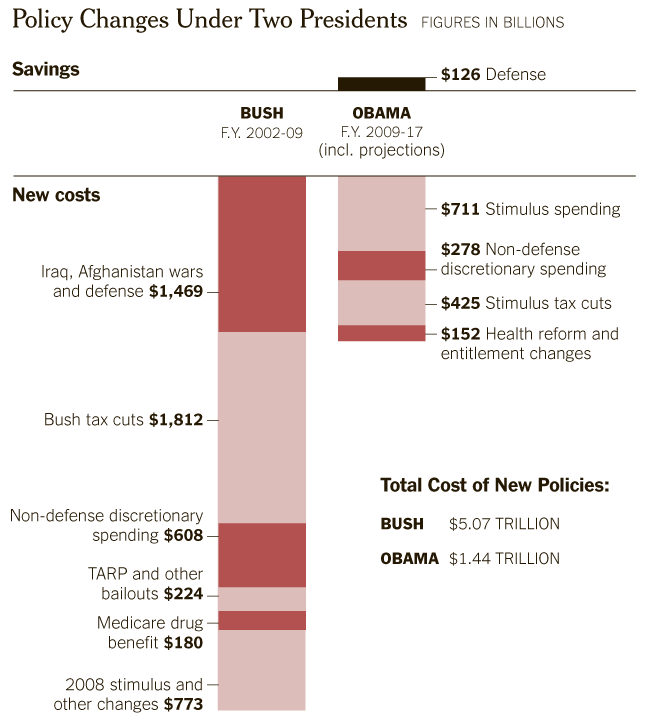
7. New, peer-reviewed research on global warming is not encouraging: "At last year’s annual American Association for the Advancement of Science meeting, UC Santa Barbara’s William Freudenberg gave a presentation in which he revealed that “new scientific findings are found to be more than twenty times as likely to indicate that global climate disruption is ‘worse than previously expected,’ rather than ‘not as bad as previously expected.’” Yikes. (source)
8. Politifact verifies the reality: "The top 1 percent of all income earners in the United States made 23.5 percent of all income -- more than the entire bottom 50 percent. The percentage of income going to the top 1 percent has nearly tripled since the 1970s. In the mid-1970s, the top 1 percent earned about 8 percent of all income. In the 1980s, that figure jumped to 14 percent. In the late 1990s, that 1 percent earned about 19 percent." Meanwhile, preserving slightly lower marginal tax rates for these wealthy folks seems to be the only major policy goal of the Republican party. (source)
Movie recommendation [Bryan]
I've been meaning to blog about this for some time, but I wanted to recommend the movie, Another Year, directed by Mike Leigh (I was previously unfamiliar with Leigh's films, but apparently he is a big deal among the movie intelligentsia). Warning: The movie is conversation driven, amounting to about 2 hours of talking, so I guess it isn't for everybody. It depicts a marriage, where a husband and wife appear to genuinely delight in their long-term relationship. The movie captures the day-to-day reality of a stable, happy marriage in a completely convincing way. Indeed, what is great is how this movie captures the communicative nuance of everyday life. Every facial expression, every eye movement, every verbal tick, every raised eyebrow is pitch perfect. The movie contrasts the marriage of the main characters, Gerri and Tom, with the storms of loneliness experienced by the people who surround it. It makes you think about the ideas of loneliness and love, where they can be found, what causes them, and how people who experience both love and loneliness affect each other. Highly recommended.
Saturday, July 09, 2011
Columbus Reborn [Bryan]
For a long time, I had the sense that Columbus really lacked an identity, or even a sense of place. The city has been disconnected from its past and has been lacking a vision for the future. I can't tell you how many grand landmarks have been torn down, how many businesses have fled downtown, how much the waterfront (the key to a great city) was lacking in character and imagination, and so forth. Columbus, I felt, was a "convenient" city, but that was about all that could be said for it.
In the past few weeks, I've really changed my mind. I've strolled around the newly hip and vibrant Short North District, hung out again at Schiller park in German Village taking in a free play, and marveled at the connection Columbus somehow has with the Royal Shakespeare Company, which produced an amazing kid-friendly (!) production of Hamlet last month. However, the key to the resurrection of Columbus, in my mind, is the new parks downtown. They have really gotten serious about reshaping their public places in the city and it is really paying off. There is now a string of parks along the Scioto River, the "Scioto Mile," all interconnected by bike paths. There is now the biggest splash park I have ever seen, which will draw families back to downtown. There is a new central park in place of the old City Center Mall, Columbus Commons, which comes complete with a carousel, an outdoor library, beautiful gardens, and European-style outdoor cafe. There are pedestrian-friendly bridges linking the east and west banks of the Scioto, meaning that people can easily walk from COSI to downtown (the new Main Street Bridge is the first inclined arch bridge in North America). The central park is linked to the waterfront parks by cobblestone streets and urban gardens. Very cool. Behold a city reborn!



In the past few weeks, I've really changed my mind. I've strolled around the newly hip and vibrant Short North District, hung out again at Schiller park in German Village taking in a free play, and marveled at the connection Columbus somehow has with the Royal Shakespeare Company, which produced an amazing kid-friendly (!) production of Hamlet last month. However, the key to the resurrection of Columbus, in my mind, is the new parks downtown. They have really gotten serious about reshaping their public places in the city and it is really paying off. There is now a string of parks along the Scioto River, the "Scioto Mile," all interconnected by bike paths. There is now the biggest splash park I have ever seen, which will draw families back to downtown. There is a new central park in place of the old City Center Mall, Columbus Commons, which comes complete with a carousel, an outdoor library, beautiful gardens, and European-style outdoor cafe. There are pedestrian-friendly bridges linking the east and west banks of the Scioto, meaning that people can easily walk from COSI to downtown (the new Main Street Bridge is the first inclined arch bridge in North America). The central park is linked to the waterfront parks by cobblestone streets and urban gardens. Very cool. Behold a city reborn!


Subscribe to:
Posts (Atom)