I just finished grading a whole bunch of exams. It is always a relief to finish that dismal task.
Whenever I make comments on student papers or exams, I always think back to a comment one of my professors made. I think it was my history of physics class. It was an essay exam. I had written a little essay, and I can't even remember what the topic was. I thought I did fairly well. I didn't have the most precise conception of what I was saying, to be sure, but I thought it was good enough to get partial credit. A week passed and I got the exam back. I looked eagerly to see my grade and the comments that had been written. Usually, comments on my papers were fawning and highly complimentary. Not this time. This time the only response was written in red ink at the bottom of my essay.
It said, simply, "Not so."
That was it. No explanation. No pretending to engage with what I'd written. No illusions that my response was worth more than the pencil stratches I'd used to vomit out my answer. Just a flat and simple contradiction. A pin prick to a balloon full of intellectual hot air.
Not. so.
It was a deflating moment. I was, with those two words, once again clear on where I stood in the world of true minds. I laugh about that moment today. And, every once in awhile I, too, write on a student paper the simple phrase: Not so.
Bryan
Thursday, October 26, 2006

Friday, October 06, 2006
I've been cited!
One of the great anxieties in my life right now is when other people actually read the stuff I write. Sometimes I wish they wouldn't. Sometimes I wish my thoughts would simply fly off into nowhere leaving only the trace of a line on my curriculum vitae. Usually, I can't stand re-reading something I've just published, and I can't imagine why anyone else would want to do so. Here are two recent citations of my work (some of my first, actually).
After reading my paper on religion and educational theory, one writer responds:
Another citation, less positive. After reading my paper on cadaver dissection, one writer snipes:
Is it true there is no such thing as bad publicity?
Bryan
After reading my paper on religion and educational theory, one writer responds:
"As someone who has not bee religiously observant since secondary school, I find W's words unsettling but compelling. He seems to challenge the norms upon which our discipline is founded. Perhaps this is the paralogy that is most needed now -- a paralogy that crosses the boundary that is imagined to separate the religious from the secular. While paralogy for the sake of legitimation alone will be seen as terroristic and may prove counterproductive, this paralogy comes form an openness to the radical incommensurability of the language games that constitute our scoeity. It invites new possibilities to emerge."Got it? I'm not sure I do either. Whatever the case, who would have thought that "unsettling and compelling" would be a way of describing me?
Another citation, less positive. After reading my paper on cadaver dissection, one writer snipes:
"The only review of quantitative research into dissection so far [footnote], sometimes misleading quoted [footnotes], deals mainly with dissection in high school classes."Guess who quotes misleadingly. Yup, me. What's funny is the guy really liked my paper except for that little snippet. And yet, what do I get recognized for -- being "misleading."
Is it true there is no such thing as bad publicity?
Bryan
Wednesday, September 27, 2006
Okay Edge, play the blues...
So, the bishop began a conversation last Sunday in the following way: "They've decided to split the early morning seminary class and they need a teacher."
Let me assure you that there is no good way this conversation can end. Arrgh!
Bryan
Let me assure you that there is no good way this conversation can end. Arrgh!
Bryan
Friday, September 22, 2006
Bryan's Trip to the Ruby Mountains
At the end of August, I had a great trip with my brother Derek and uncle Brent to the Ruby Mountains. The Ruby Mountains are in Nevada, actually, near Elko. If your impression of Nevada was like mine, there is nothing really to see there. On the contrary. The Rubies are a gem of a mountrain range -- as nice as anything in the Rocky mountains (if not as extensive).
 On Sunday, the 27th, we spent the night in the neat little Pine Lodge in Lamoille, NV, at the base of the mountains. Pine Lodge also has a great little steakhouse. The chicken wings were especially good! Here is a picture of the famous Lamoille Presbyterian Church.
 Here we are starting out.
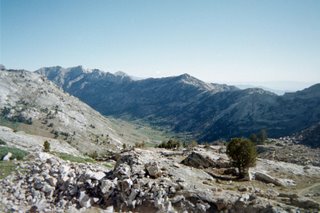 On the first day we hiked up Lamoille Canyon...
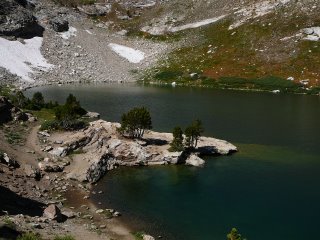 ...stopped at Lamoille Lake...
 ...went over the breathtaking Liberty Pass...
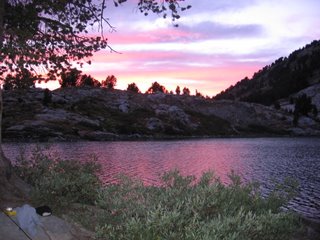 ...and established our base camp near Liberty Lake -- the quintessential mountain lake.
 On the Second day, we left our camp and hiked a portion of the "Ruby Crest Trail"...
 ...ascended various peaks and passes...
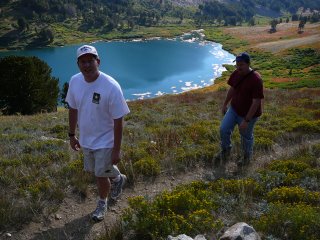 ...got really tired...
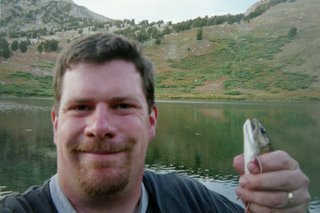 ...and caught some fish down at Favre Lake.
 Here I am hiking out on day 3.
Other pictures:
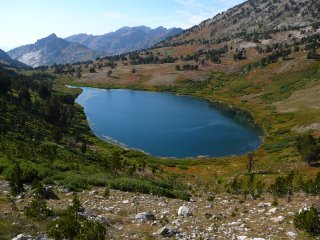
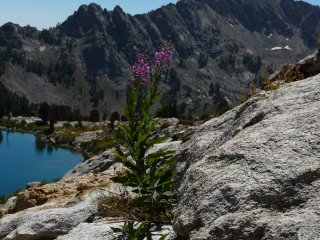
 On Sunday, the 27th, we spent the night in the neat little Pine Lodge in Lamoille, NV, at the base of the mountains. Pine Lodge also has a great little steakhouse. The chicken wings were especially good! Here is a picture of the famous Lamoille Presbyterian Church.
 Here we are starting out.
 On the first day we hiked up Lamoille Canyon...
 ...stopped at Lamoille Lake...
 ...went over the breathtaking Liberty Pass...
 ...and established our base camp near Liberty Lake -- the quintessential mountain lake.
 On the Second day, we left our camp and hiked a portion of the "Ruby Crest Trail"...
 ...ascended various peaks and passes...
 ...got really tired...
 ...and caught some fish down at Favre Lake.
 Here I am hiking out on day 3.
Other pictures:


Wednesday, September 13, 2006
Summer Photos
Well, I guess the summer is officially over. Here are some pictures of what we've done this summer (and late Spring).
 We repainted our kitchen.
 We also repainted our living room and (finally) bought some decent furniture.
 We watched Andrew grow up.
 We were visited by our good friend from Champaign, the Cassavaughs.
 We went to the Columbus Arts Festival. Nora recieved this clown's nose and a little pink disco ball from members of the Gay Choir of Columbus -- we thought that was nice of them. (Note: we also went to several of the free Shakespeare in the park plays that Columbus offers in the German Village area, but don't have any photographic evidence that we did -- be assured that it was cool, though).
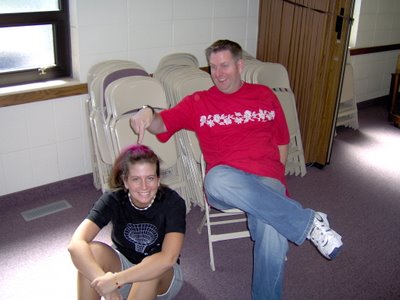 In late June, we went to visit family in Utah.
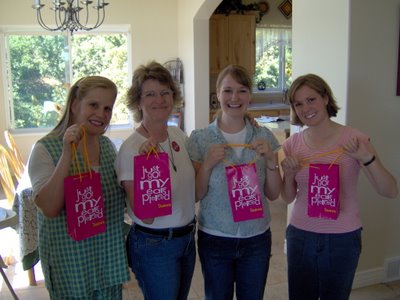 While in Utah, we welcomed Aunt Anna home from her LDS mission in Chile (she is Ellie's sister on the far right). Ellie, her sisters, and her mom all got their ears pierced for the first time.
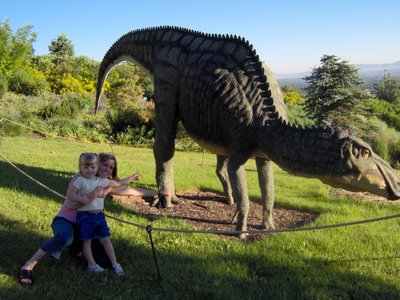 We went to Red Butte Gardens above the University of Utah campus.
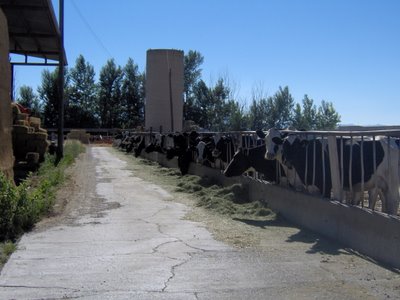 We saw the cows at The Farm (my Grandpa's farm) for the last time. Sad. The Farm is now being sold to a real estate developer (a minion of Satan) who will turn the farm into a subdivision with big houses for people who know nothing of the history of the land on which they are living.
 Nora got to play with her cousins.
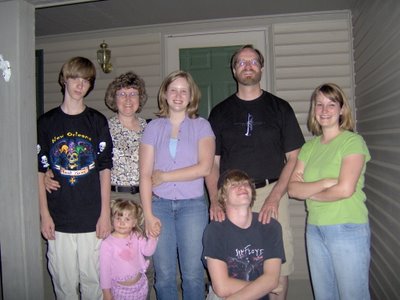 Back in Ohio, we had a nice visit with Ellie's uncle Ralph and aunt Cathy from Virginia.
 We played around a lot on the slip-n-slide.
 We went to the Franklin County fair. Nora is sitting with her friend Rachel.
 Andrew had ear surgery -- tubes.
 We discovered a fun little beach on Deer Creek Reservoir, about 45 minutes away from our house.
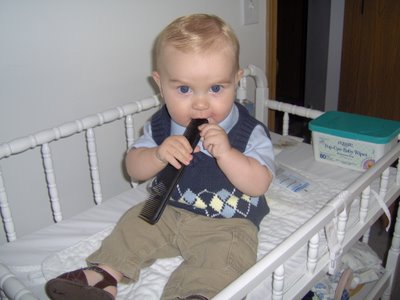 We continued to watch Andrew grow up.
More pictures to come soon.
Bryan
 We repainted our kitchen.
 We also repainted our living room and (finally) bought some decent furniture.
 We watched Andrew grow up.
 We were visited by our good friend from Champaign, the Cassavaughs.
 We went to the Columbus Arts Festival. Nora recieved this clown's nose and a little pink disco ball from members of the Gay Choir of Columbus -- we thought that was nice of them. (Note: we also went to several of the free Shakespeare in the park plays that Columbus offers in the German Village area, but don't have any photographic evidence that we did -- be assured that it was cool, though).
 In late June, we went to visit family in Utah.
 While in Utah, we welcomed Aunt Anna home from her LDS mission in Chile (she is Ellie's sister on the far right). Ellie, her sisters, and her mom all got their ears pierced for the first time.
 We went to Red Butte Gardens above the University of Utah campus.
 We saw the cows at The Farm (my Grandpa's farm) for the last time. Sad. The Farm is now being sold to a real estate developer (a minion of Satan) who will turn the farm into a subdivision with big houses for people who know nothing of the history of the land on which they are living.
 Nora got to play with her cousins.
 Back in Ohio, we had a nice visit with Ellie's uncle Ralph and aunt Cathy from Virginia.
 We played around a lot on the slip-n-slide.
 We went to the Franklin County fair. Nora is sitting with her friend Rachel.
 Andrew had ear surgery -- tubes.
 We discovered a fun little beach on Deer Creek Reservoir, about 45 minutes away from our house.
 We continued to watch Andrew grow up.
More pictures to come soon.
Bryan
Monday, September 11, 2006
September 11, 2001
It was a beautiful morning in Columbus today. Just like it was in Champaign five years ago. Just like it was in New York City five years ago.
I had gone through my normal morning routine as a graduate student, rolling out of bed around 8:30 or so, and arriving at campus to attend the lecture portion of the "Introduction to Mythology" course where I was serving as a TA. It was then that I realized that something had gone terribly wrong that day. Attendence was unusually sparse, and the instructor of the course called for a moment of silence for "those who were buried in the rubble and those who were trying to save them." He didn't explain what had happened, assuming everybody already knew. I hadn't heard anything. I went to my computer after class and looked up the NY Times webpage. Information was sparse. It had a simple title: "Airplances crash into Twin Towers; Both Buildings Collapse." I couldn't believe what I was reading. I thought it was a hoax.
The rest of the day was spent in front of the television in the student union and at home. I remember a sucession of images, each more sad than the last. Images of people falling. Images of people hanging out of windows. Images of panic. And, later, images of people desperately searching for loved ones. Images of walls full of photos of the dead and missing. I remember particuarly the images of a young woman, not much older than a teenager, holding a picture of her mother and begging the television audience (begging me on my sofa in Champaign!) to give her information, any information, about her mother -- a mother of several small children, the young woman's siblings. It was then that I finally lost it, drowned in sea of such images.
The day was peppered with small, memorable conversations, as people tried to understand what was happening and why. I remember talking with my advisor about the events of the day. He said simply that he was afraid -- afraid of what had happened and afraid [prophetically] of what would come after.
I did not know anyone who was killed on September 11. But that day changed me, perhaps more than any other single day of my life. More than any other day, that day told me that all was not well in the world. I didn't know who to blame, and I still don't. Not entirely. I know to blame hate, and fear, and ignorance. I know to blame that part of human nature that makes us want to think that we, and only we, have all the right answers. I know to blame that part of us who thinks we can all solve our problems through force, intimidation, and violence. I know to blame that part of us that wants to swagger and to have our enemies "bring it on." But to blame these things is simply to blame human nature, or a part of human nature -- that hateful part of human nature of which we are all comprised and from which, it seem, we are doomed to never escape.
September 11 was the day my professional life became trivial. Before that time, I was busy writing papers on Heidegger, the nature of metaphor, and the finer points of philosophical debates in epistemology. After that time, such pursuits lost much of their meaning. Who cares about such things when there are mothers being burned alive? When soldiers are deploying? When children await parents who will never come home? I couldn't muster any motivation to care about my studies in the days and weeks after the attacks. And since that time, I have never escaped the doubts that my life -- the life of comtemplation, teaching, and writing -- doesn't matter much. In the world of tough guys that was introduced on 9/11, people like me don't matter much.
I remember walking around the afternoon of September 11th. Every church on campus had its door open. I walked into the Episcopal church near the main library. The priest was busy offering prayers and a handful of people were kneeling. I listened to the prayers of another religion, but felt that it was also my religion. I remember seeing the long lines of people, ready to give blood, and I felt as if we were all really of the same blood. I felt ready to do whatever it took to solve the problems we faced.
But, then, it seems we couldn't find an answer that fully satisfied our national psyche. First came the war in Afghanistan. Then came the war in Iraq -- a war, unfortunately, that began the week my dear daughter Nora was born. Both wars now continue, with things getting worse everyday. Thousands upon thousands of more people have been killed. The hatred that was so clearly manifest by 19 highjackers has spread like a wildfire. Images of death and suffering have grown. The images of 9/11 have been replaced by images that are equally powerful. A young widow of an American solider, killed without meeting his daughter. Images of dead children being pulled out of buildings bombed by American aircraft. And the image below, the most recent image that touched me, and almost made me lose it.
I don't know much about this photo. There sits a prisoner, a father it seems. Perhaps he is a terrorist; perhaps just an innocent man caught up in one of our wild midnight raids. He sits in the desert with a black bag over his head and tries to comfort his obviously exhausted and probably terrified son. This is the fallout of 9/11. How can we make the world better for this boy? How can we make the world better for the girl on 9/11 with the missing mother? I wish I knew. 9/11 for me opened a flood of questions I have never fully answered.

Bryan
Wednesday, August 16, 2006
My deep ancestry
So we got my dad a National Geographic DNA testing kit for a Father's Day present. Apparently the results are in. My Dad writes:
Everyone that has my DNA belongs to Haplogroup R1b (M343). A haplogroup is a series of markers that defines the mutations in your DNA and is shared by your ancestors (the men in my case). According to the information I received, my earliest ancestor emerged in Africa about 50,000 years ago. About 5000 years later they moved to the Middle East. About 5000 years later they moved to Central Asia. They moved further into Asia during the next 5,000 years. This was during an ice age and survival was difficult so they moved to Northern Europe and later to Western Europe. This is where our ancestors got the M343 marker – the defining marker of our haplogroup. We are direct descendants of the Cro-Magnon man that did all the cave paintings in France.
Tuesday, August 15, 2006
Internet explorations
I was playing around with Google Trends today when I should have been working. Google Trends allows you to see what people are searching for on the internet and when. I typed in the name "Warnick," not expecting any results. Here is what I found. Apparently, in Late October, 2005, there was a huge surge in people searching the name "Warnick." I wonder what the heck was going on at that time to make people interested in searching for the name "Warnick." The surge in searches did not seem to correlate with any significant news involving Warnicks. Anyway, the most popular search regions for the name "Warnick" are:
1. Salt Lake City, UT, USA
2. Boston, MA, USA
3. New York, NY, USA
4. Seattle, WA, USA
5. Chicago, IL, USA
6. Toronto, Canada
Funny that the good people of Toronto should be so interested in Warnicks. What's up Toronto?
Another cool site is Pandora.com, which helps you find music that you like. You simply type in a group or song that you like and the site matches the characteristics of the group or song with other groups. My favorite rock and roll song of all time is "Until the End of the World," by U2. Typing that in, I found that I like music with subtle harmonies, mixed acoustic and electric guitar, extensive vamping, repetive melodic phrasing. The list of music this has generated has been great so far. From other searches, I found that I like folk roots, minor key stuff, and, um, "breathy male vocals."
Bryan
Tuesday, August 08, 2006
Mean t-shirt
Ellie and I saw a t-shirt the other day that made us wince. It simply said:
NOBOBY CARES ABOUT YOUR BLOG
NOBOBY CARES ABOUT YOUR BLOG
Friday, August 04, 2006
My response to Bryan's list. (For the record, I knew all those things about him.) Items are in random order. . .
Favorites
1. Homemade rootbeer
2. Going to the fair
3. The sizzling sound a sparkler makes when you douse it in a bucket of water
4. Eating a handful of freshly fallen snow
5. Sleeping in a cold bedroom
6. Getting an unexpected letter in the mail
7. Washing a floor on my hands and knees (it’s nuts, I know, speaking of which - )
8. Hazlenut-flavored chocolate
9. Endorphins after running
10. Reading a good book on a rainy afternoon
11. People who aren't afraid to use big words
12. Clean bedsheets
Least Favorites
1. Getting into a hot car
2. Books with dumb endings
3. Finding a bleach stain on my new clothes
4. Cleaning my room – or my daughter’s
5. Little yappy dogs
6. Finding out they don’t carry ______ in my size
7. People who play dumb
8. Beauty pageants and/or popularity contests
9. Being called “Sweetie” by salespeople my age
10. Days with no ice cream
11. Our deathly slow computer
12. Shaving my legs (it's so dangerous!)
Ellie
Friday, July 28, 2006
Some things you probably didn't know about Bryan
Here they are, in no particular order:
1. I passionately crave buttered popcorn and eat it almost every night.
2. I really like Madonna. Material Girl -- yeah!
3. I always get nervous before I teach. Even a youth Sunday School Class.
4. I never, ever, say no to warm chocolate chip cookies.
5. In airplanes, I always turn the air valve on full blast no matter what the temperature.
6. I’m semi-claustrophobic (see 5).
7. I will sometimes look at you like I know what you’re talking about, when really I have absolutely no idea.
8. I believe that days that start out with a sugar cereal are better than days that do not.
9. I don’t floss much.
10. Sometimes I laugh at jokes I don't think are funny, and don't laugh at jokes I find hilarious.
11. I find babies kind of boring -- give me a toddler any day!
12. I believe one should never buy a cheap car, but also that one should always take the bus.
13. Speaking of buses, if I see a person reading something on the bus, I can't rest until I find out what they are reading.
Friday, July 07, 2006
Friend's blogs
Finally, Jared has something interesting on his blog. Be sure to check it out. The comments section, though, alleging that I once was found lacking in fashion sense, is scandalous and should be ignored by all decent people.
I also got to read all about David Chapman's Father's Day celebration. Apparently, old Chappo got a grill AND was able to buy himself a coveted bike trailer. I got, um, a couple DVDs.
I also got to read all about David Chapman's Father's Day celebration. Apparently, old Chappo got a grill AND was able to buy himself a coveted bike trailer. I got, um, a couple DVDs.
Barack Obama
I once heard Barack Obama speak once at the University of Illinois. Ever since that time, he has been my favorite politician, by far. I know, I know. He has been way hyped. But in his case, for now at least, I think the hype is real. He is by far the most thoughtful speaker in pulic life today. Check out this talk on the relationship between religion and politics. You'll see.
Thursday, July 06, 2006
Two Interesting Mormon Links
You never really know what you'll find on the Internet these days. Many of you probably already knew this, but I just found out that Glen Larson was Mormon. Larson was the guy who wrote/produced shows like Knight Rider, Buck Rogers, Magnum PI, the Fall Guy, and, most intersting, Battlestar Galactica. Battlestar Galactica was one of my favorite shows as a kid. Now, wouldn't you know it, but apparently there are all sort of Mormon allusions spread around the old show. See here, and here, and here.
Also, I recently found out there is a society for LDS Skinny dippers and nudists called "LDS Skinny Dipper Connection." Their motto is "Familes Forever Naked and Not Ashamed." You can go to the website without fear -- there is not nudity. A joke possibly?
Also, I recently found out there is a society for LDS Skinny dippers and nudists called "LDS Skinny Dipper Connection." Their motto is "Familes Forever Naked and Not Ashamed." You can go to the website without fear -- there is not nudity. A joke possibly?
Friday, June 02, 2006
WalMart and Me
My buddy Jared is always going ff about the evils of Walmart. I can't say I blame him. A massive company with the almost single-handed ability to kill off the American worker once and for all. A detestable company, in almost every way imaginable.
And yet...and yet...I can sometimes be found roaming the local supercenter. It is the closest store to us, and also the cheapest, and it will have almost everything we want. The service is almost always poor, but it also has the best root-beer available (no, really). It is also the home to our local Papa Murphy's Pizza. The combination of these factors too often proves an irresistable temptation. Count me as a sheep, cared for the shepard of consumer culture!
Bryan
Tuesday, May 23, 2006
Juan Cole on Da Vinci
Juan Cole's take on the Da Vinci code:
Bryan
Despite the scowls and titters of the critics, the DaVinci Code did $77 million at the box office in the US, better than Tom Cruise pulled in MI3. And the world-wide gross is already $224 million.
What in the world accounts for the popularity of this complicated and improbable story?
Dan Brown's narrative is about restoring the happy medium to contemporary Western modernity.
The novel has a binary structure. On the one hand you have the Church hierarchy, which is patriarchal, doctrinal, monotheistic, ascetic, and authoritarian. Those attributes are its normal pole, but it is open to corruption when they are over-emphasized. The first step toward over-emphasis is Opus Dei, which stands for a cult-like kind of monotheism in which individualism is much more surpressed than in the Church generally. But even Opus Dei is not so far from churchly normality. The villain of the movie is the man who corrupts the principles of Opus Dei itself, Bishop Manuel Aringarosa and his acolyte, Silas. They take self-denial in the direction of manic masochism, so that Silas routinely inflicts excruciating pain on himself in emulation of the crucifixion. And he has moved so far in the direction of giving up his individualism that he will do anything he is told by his master, including committing murder and torture. Inspector Bezu Fache, a representative of bourgeois order as a policeman, is likewise willing to put aside due process to obey his cultic master, violating individual rights and attempting to railroad a suspect, though he later has an ethical awakening.
Silas is, of course, a religious terrorist. With his monk robes, he inevitably nowadays evokes Bin Laden and al-Qaeda. Corruption of an authoritarian and partiarchal tradition leads in the direction of murder for the faith.
This pole of the film reflects the authoritarian side of modern institutions and culture. It isn't about Catholicism at all, or about Opus Dei. It is about the unchallengeable doctrines (norms) of society, and about the constant danger that ordinary obedience to the law can turn into a cultic exaltation of the law above principle and spirit. The Silas's of the US are the Ollie Norths and the Irv Lewis Libbys, apparatchiks who are willing to break any law and throw over any constitutional principle in order to serve their masters. (I.e. Cheney gets to play Aringosa in the Plame scandal). As for patriarchy, it is still dominant in much of American life, from the presidency to the CEOs in the boardroom to the US officer corps, and it is linked to the bands of brothers who form gangs and go overboard in imposing conformity. Joe Wilson had to be punished for challenging the orthodoxy that Iraq had weapons of mass destruction.
The other pole in the Brown narrative is the priory around the female descendants of Jesus through Mary Magdalene. This pole is about paganism, feminism, individualism, scientific rationality and sexual freedom. This pole, likewise, can become corrupt and antinomian. Thus, the pagan orgy or hieros gamos repulses Sophie Neveu and causes an almost fatal break between the Grail (herself) and the priory. Likewise, scientistic society has led her to become an unbeliever, so that the Grail itself is corrupted by doubt. Sir Leah Teabing is the symbol of this pole gone to unethical extremes. In his quest for the Grail, he is willing to deceive and to kill. He is Silas's structural analogue.
The "pagan" (in Brown's sense) temptation is a significant feature of contemporary American life-- which can be lived without much immediate penalty as libertine, selfish, and undisciplined. Untempered by spirituality and ethics, science can be soulles and led to e.g. eugenics experiments.
Neveu, like Fache, is in the police and a symbol of middle class order. But she is willing to put her ethics above her professional discipline. When she sees that Fache has become a cultist and lost his perspective, she defies him and helps the fugitive Professor Langdon. She stands for genuine justice rather than only procedural justice.
The film is popular because it isn't about Catholicism or France or some odd conspiracy theory centered on Mary Magdalene. It is popular because it is about the dilemmas of secular modernity.
As a film, it has its disappointments. The figure of Langdon does not actually speak like an academic. His talk at the Louvre is a sermon, not an analysis. His arguments with Teabing are jejune and the substance unbelievable. There is too much exposition, too much explaining and dwelling on the details of the whole gnostic conspiracy theory. To be good, the film would have had to be more allusive and less preachy, to show not tell.
Still, it did big box office, and is hitting a nerve. Critics should be interested in what that nerve is.
Bryan
Wednesday, May 10, 2006



Subscribe to:
Posts (Atom)