I’m starting to realize that there’s a big difference between being nice and being kind. While the two may be manifest in similar types of actions, the distinction lies in the thought behind the actions. Nice has an element of artifice to it. Someone described as extremely nice might actually be considered phony or simply over-the-top in their friendliness. But you can never be too kind. Kindness has a genuineness and unmistakable sincerity about it. Kind is what I want to be.
Recently I learned that someone I just met doesn’t like me. Friends familiar with the situation console me that this person has undeniable issues that cloud the person’s ability to respond normally to others. Add to this the fact that the person doesn’t really know me—has had only a handful of experiences with me, in fact—and it is absolutely clear to everyone but me that I should disregard the animosity and move on. But it bothers me. First it bothers me that the person disliked me immediately. Do I make such a bad first impression? Then the reason the person gives others for not liking me is disturbing: I am too happy. Too happy? Huh?
I’ve agonized over the issue (obviously) and critiqued into the ground every interaction I’ve ever had with the person. Is happiness a problem? Do I smile too much? Am I too enthusiastic? Did I try a little too hard to make the person like me? And I’ve concluded that it all harks back to this issue: the difference between nice and kind.
I think what I’ve been to this person since the moment we met is nice. I’ve smiled big, complimented, inquired about the person’s life and interests, and overall assumed a chumminess and familiarity that could be nothing but artificial under the circumstances. After all, I hardly know the person. I’ve been relentlessly friendly despite unspoken but clearly perceived messages from the person and from others that friendliness might not be welcome. I believed myself the exception—niceness from me would be welcome, other just weren’t trying hard enough.
Well, then came the reality check: an outright rejection of me and my accursed friendliness. After a lot of reflection this is the only way I can wrap my mind around the response. The person is prickly and expects to be treated warily. Someone like me barreling in with my battering ram of niceness, trying to move through the thorny exterior is not only trespassing, but bound to get jabbed. So I got jabbed. I hope I’ll gain some wisdom from the experience.
Here’s what I’ve gotten so far. Don’t be too nice. A nice person exudes a certain impenetrable joviality and self-satisfaction that feels condescending from the receiving end. Someone who is nice to you doesn’t necessarily know you or like you. Niceness is centered on the needs of the person giving it and disregards the condition of the receiver. Niceness is impersonal.
Be kind instead. Kindess is more subdued. It is built on mutual experience; where experience is lacking, it is founded on empathy. Kindness requires knowing, understanding, and accepting. Kindness ponders both the heart and the situation of the receiver; the giver is only a conduit through whom the love of God can flow. Kindness is deeply personal. Kindness has love behind it.
I may have lost my chance to befriend this person who is so obviously in need of friends. I hope not. But I have learned for the future that where my sometimes superficial (though well-intentioned) niceness is unwelcome, kindness will likely never be rejected.
Ellie
Monday, February 27, 2006

Monday, February 20, 2006
The Life of an Introvert
Sometimes, you just come along a quote that sums up your experience perfectly. Here is one that spoke to me, via Kevin Drum.
Bryan
I marvel at [my extrovert friend] who can always somehow turn the conversation right over effortlessly and keep it going even when what he says is not necessarily profound or interesting. What he comes up with is perfectly tuned to the sense and flow of the conversation. But it's not words that are particularly intended to convey ideas or mean things. It's words that socialize — that simply continue the conversation. It's chit-chat. I have no gift for that. I have to think about what to say next, and sometimes I can't think fast enough and end up saying something stupid. Or sometimes I just come up dry and the conversation kind of ends for while until I can think of another topic.
This is why it's work for me. It takes positive cognition on my part. I think that's probably a core introvert characteristic that you and I have in common and which can probably be distinguished from shyness per se — that small talk takes conscious effort and is very hard work. There's nothing small about small talk if you're an introvert.
Bryan
Sunday, February 19, 2006
Emergency Rooms -- Hell on Earth
Over the past 8 months, Ellie and I have been to the emergency room 3 times. All three visits were caused by Nora. The first time, Nora scratched Ellie in the retina and we had to get her eye examined. The second time, Nora fell off the couch and hit her head on the coffee table (3 stiches). And just recently, Nora was apparently trying to climb up her closet, fell down, and nearly bit through her lip (3 stiches).
As we were waiting to be seen for the most recent accident, Ellie and I concluded that emergency rooms were hell on earth. It took us five hours to get in and out, which is actually fairly good compared to horror stories others have told us. The waiting in emergency rooms is interminable, the staff often uphelpful, and the cost astronomical.
Some observations:
1. Your wait time in an emergency room has little to do with how busy it seems. We once were pleased to find an empty emergency room, only to find that we still had to wait for several hours. We’ve also been repeatedly put on the “fast track,” which still entails a wait of several hours. (The “slow track” apparently is an all day experience.)
2. Ever notice how hardly anyone else in an emergency room appears to have an emergency? When we’ve gone, Ellie either had her eye bandaged or we’ve brought in a bloody and crying child. But everyone else in the waiting room has always seemed just fine. There were in our recent visit a few people who looked tired and a guy who was limping, but other that they hardly looked like they had emergencies. I’m sure all these people problems of some sort, but they never seem that way.
3. The staff never appears to be in any hurry. I’ve seen the doctors and nurses that were “caring” for us often just sitting in their offices or chatting with colleagues in the hallway, as we twiddled our thumbs waiting to be visited.
4. The division of labor is ludicrous. The attending physician can only do certain jobs apparently. The same with the residents, nurses, and nurses aides. We waited forever to get a cotton ball anesthetic taped to Nora’s lip. When it finally came to the person who was supposed to do that job, she didn’t know what she needed to do and she had to ask the nurse who then consulted the doctor. Why couldn’t the freaking doctor have simply taped on the cotton ball? Or at least have given me the stuff and gotten out of my way! Sheez.
When people say we Americans have got the greatest health care system in the world, I just think of crap like this.
Venting over.
Bryan
As we were waiting to be seen for the most recent accident, Ellie and I concluded that emergency rooms were hell on earth. It took us five hours to get in and out, which is actually fairly good compared to horror stories others have told us. The waiting in emergency rooms is interminable, the staff often uphelpful, and the cost astronomical.
Some observations:
1. Your wait time in an emergency room has little to do with how busy it seems. We once were pleased to find an empty emergency room, only to find that we still had to wait for several hours. We’ve also been repeatedly put on the “fast track,” which still entails a wait of several hours. (The “slow track” apparently is an all day experience.)
2. Ever notice how hardly anyone else in an emergency room appears to have an emergency? When we’ve gone, Ellie either had her eye bandaged or we’ve brought in a bloody and crying child. But everyone else in the waiting room has always seemed just fine. There were in our recent visit a few people who looked tired and a guy who was limping, but other that they hardly looked like they had emergencies. I’m sure all these people problems of some sort, but they never seem that way.
3. The staff never appears to be in any hurry. I’ve seen the doctors and nurses that were “caring” for us often just sitting in their offices or chatting with colleagues in the hallway, as we twiddled our thumbs waiting to be visited.
4. The division of labor is ludicrous. The attending physician can only do certain jobs apparently. The same with the residents, nurses, and nurses aides. We waited forever to get a cotton ball anesthetic taped to Nora’s lip. When it finally came to the person who was supposed to do that job, she didn’t know what she needed to do and she had to ask the nurse who then consulted the doctor. Why couldn’t the freaking doctor have simply taped on the cotton ball? Or at least have given me the stuff and gotten out of my way! Sheez.
When people say we Americans have got the greatest health care system in the world, I just think of crap like this.
Venting over.
Bryan
New Dinosaur
So, Nora has been really interested in dinosaurs lately. She knows the names of all the major varieties. Recently, I was discussing with Ellie my "Philosophy of Education" course. Nora overheard our conversation and thought "philosophy" was the name of dinosaur, which she called the "philoso-raptor."
Heck, maybe such a dinosaur did exist. After all, some dinosaurs may have become reflective about their existence. They probably didn't last long though. Poor guys.
Bryan
Heck, maybe such a dinosaur did exist. After all, some dinosaurs may have become reflective about their existence. They probably didn't last long though. Poor guys.
Bryan
U2: Questions and Redemption
Throughout their "musical journey," U2 challenges the listener with a tension between the beauty of divine promises and the ugly realities human beings confront and inflict upon one another. In their early song, “October,” we are presented with the image of an autumn tree, stripped bare of life, bracing against the oncoming winter. The tree is immediately contrasted it with the glorious idea of an eternal, unchanging being who transcends death and winters (“Kingdoms rise / and kingdoms fall / but You go on, and on”). Much later, in his song “Peace of Earth,” Bono contrasts the Christmas promise of peace with ugly realities of human history: “Jesus this song you wrote / The words are sticking in my throat / Peace on Earth / Hear it every Christmas time / But hope and history won’t rhyme / So what’s it worth? / This Peace of Earth?”
Within such a framework of glorious, but seemingly forever deferred promises of redemption, U2 seems to suggest that questioning can be an act of faith. Thus, their song “Wake up dead man” becomes a simultaneous act of affirmation and questioning: “Jesus / I’m waiting here boss / I know you’re looking out for us / but maybe your hands aren’t free.” Taken to an extreme, this attitude culminates in the rather sympathetic portrayal of Judas Iscariot in U2’s masterpiece song, “Until the End of the World.” Judas seems to say to his betrayed Lord: “In my dream I was drowning sorrows / But my sorrows they learned to swim … / In waves of regret, wave of joy / I reached out for the one I tried to destroy / You, you said you’d wait until the end of the world.” Judas, acknowledging guilt, reaches out to someone who, thankfully, has deferred final judgment into the future. The eternally deferred redemption allows for an eternally possible repentance – if only we can bring ourselves to do it.
The spiritual elevation of questions, confusion, and doubt, however, is matched by an equally strong celebration of divine promises. U2, follow up their questioning refrain of “Peace on Earth” with a gentle ballad called “Grace.” In this song, Grace, personified as a divine female force, quietly works to clean up the messes of human life: “What once was hurt / What once was friction / What left the mark / No longer stings / Because Grace makes beauty / Out of ugly things.”
So, how does one navigate a theology that simultaneous celebrates divine promises with one that recognizes (as we must recognize) that the fulfillment of such promises is often delayed or absent? Bono’s answer is simply to wait, to seek, and to persist. “If you walk away, I will follow,” Bono proclaims, betraying an attitude persistent, even stubbornness, in awaiting a forever-not-yet-arrival of a redeeming Messiah. Even if you still haven’t found what you’re looking for, there is spirituality in the quest itself.
The latest album sums up the spirituality of questioning, the acknowledgement of forever deferred redemption, and the value of persistent waiting. In the last song, “Yahweh,” Bono calls out for help in transforming himself into something better (“Take these hands / Teach them what to carry”), and then slurs the divine name to sound very much like a repeated chant of “Yeah I’ll wait.”
Yahweh, Yahweh
Always pain before the Child is born
Yahweh, tell me now
Why the dark before the dawn?
Within such a framework of glorious, but seemingly forever deferred promises of redemption, U2 seems to suggest that questioning can be an act of faith. Thus, their song “Wake up dead man” becomes a simultaneous act of affirmation and questioning: “Jesus / I’m waiting here boss / I know you’re looking out for us / but maybe your hands aren’t free.” Taken to an extreme, this attitude culminates in the rather sympathetic portrayal of Judas Iscariot in U2’s masterpiece song, “Until the End of the World.” Judas seems to say to his betrayed Lord: “In my dream I was drowning sorrows / But my sorrows they learned to swim … / In waves of regret, wave of joy / I reached out for the one I tried to destroy / You, you said you’d wait until the end of the world.” Judas, acknowledging guilt, reaches out to someone who, thankfully, has deferred final judgment into the future. The eternally deferred redemption allows for an eternally possible repentance – if only we can bring ourselves to do it.
The spiritual elevation of questions, confusion, and doubt, however, is matched by an equally strong celebration of divine promises. U2, follow up their questioning refrain of “Peace on Earth” with a gentle ballad called “Grace.” In this song, Grace, personified as a divine female force, quietly works to clean up the messes of human life: “What once was hurt / What once was friction / What left the mark / No longer stings / Because Grace makes beauty / Out of ugly things.”
So, how does one navigate a theology that simultaneous celebrates divine promises with one that recognizes (as we must recognize) that the fulfillment of such promises is often delayed or absent? Bono’s answer is simply to wait, to seek, and to persist. “If you walk away, I will follow,” Bono proclaims, betraying an attitude persistent, even stubbornness, in awaiting a forever-not-yet-arrival of a redeeming Messiah. Even if you still haven’t found what you’re looking for, there is spirituality in the quest itself.
The latest album sums up the spirituality of questioning, the acknowledgement of forever deferred redemption, and the value of persistent waiting. In the last song, “Yahweh,” Bono calls out for help in transforming himself into something better (“Take these hands / Teach them what to carry”), and then slurs the divine name to sound very much like a repeated chant of “Yeah I’ll wait.”
Yahweh, Yahweh
Always pain before the Child is born
Yahweh, tell me now
Why the dark before the dawn?
Monday, January 30, 2006
Behind the Curtain
I have now been on the other side of the student/faculty divide for about four months. I am continually amazed at how unorganized higher education can be. At least in the circles I swim in, organizational tasks are the last thing anyone wants to do – time is better spent with students, reading, or writing. I certainly didn’t become a professor to ruminate over bureaucratic minutia, and nobody else did either. This does breed some surprising ways of doing things. Or perhaps shocking is a better word.
When I was applying to graduate schools, for example, I obsessed over my “statement of purpose.” This is a document that explains an applicant's future plans and research interests. I had this picture of graduate student selection committees poring over every word of my statement, ready to reject me at the slightest hint of naivety. I wrote it and rewrote it, taking hours of my time (and Ellie’s time, too). In the first meeting where the graduate admissions were discussed here at OSU, however, I was interested to find out that hardly anyone had even glanced at the application materials, let alone studied them with any care. I certainly hadn’t. The process simply consisted of a quick check of the “numbers” and a quick skimming of the statement of purpose, if even that. And all this was done by only a few members of the committee. (The letters of recommendation seem to be joke that no one really takes seriously -- they all seem to say the same thing). These applications, which many applicants had obsessed over for hours, were given only 30 seconds consideration. And remember these can be life changing decisions!
When I was applying to graduate schools, for example, I obsessed over my “statement of purpose.” This is a document that explains an applicant's future plans and research interests. I had this picture of graduate student selection committees poring over every word of my statement, ready to reject me at the slightest hint of naivety. I wrote it and rewrote it, taking hours of my time (and Ellie’s time, too). In the first meeting where the graduate admissions were discussed here at OSU, however, I was interested to find out that hardly anyone had even glanced at the application materials, let alone studied them with any care. I certainly hadn’t. The process simply consisted of a quick check of the “numbers” and a quick skimming of the statement of purpose, if even that. And all this was done by only a few members of the committee. (The letters of recommendation seem to be joke that no one really takes seriously -- they all seem to say the same thing). These applications, which many applicants had obsessed over for hours, were given only 30 seconds consideration. And remember these can be life changing decisions!
Tuesday, January 17, 2006
Judas Iscariot: A bad rap?
An interesting article about Judas Isacriot. Apparently, the NT evidence that he delibertly "betrayed" Jesus is quite scanty.
Monday, January 16, 2006
Goodbye, Omnipotence
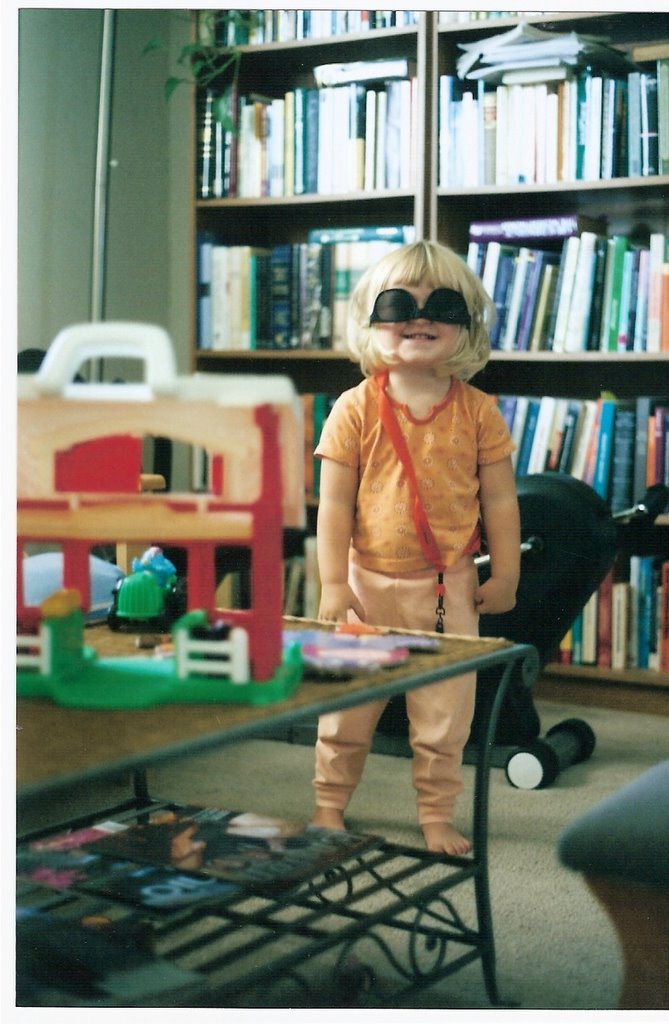
It’s happened. I knew it would someday, and yet it’s come on so slowly I almost didn’t notice it. My child has developed a mind of her own.
I’ve bragged to friends and relatives about how sweet and obedient my daughter is, basically since she was born. Whenever I left her with others for a while, I came back invariably to reports of how good she’d been, how well she’d played with other children, how she knew the answers to all the questions.
But she’s had a lot of upheaval in her life this past year—a new home, new state, new friends, new nursery classes, new baby—and somehow amid these changes, my perfect little girl has turned into a terror. Or maybe she’s just become an average child.
I saw the change in her eyes a few days ago when I asked her to do something, I don’t even remember what it was, something trivial like put on her coat or turn off the TV. She looked straight at me and said, “No.” Now, I’m not claiming that she’d never said no before. She did, and fairly frequently. The difference, as I said, was in her eyes. Somehow mirrored back in those baby blues was her clear understanding that she really didn’t have to do what I asked. In that moment, she had gained power: I knew she had it; she knew she had it; she knew I knew she had it.
It’s unsettling—almost horrifying, really—to realize that she knows she has the power to choose. I guess choosing is what life’s all about, and I just must come to grips with it. But it opens up whole new, frightening possibilities I hadn’t really considered. She might choose to do things that hurt herself or her family or others. She might choose to run away or reject what we teach her. She might choose badly.
Up till now, it’s been easy for me to see her as an extension of myself. I’ve just assumed she’ll be like me and choose things that I would choose for her. My beliefs seem naïve and comical, looking back on them, but as she is my first child, they have existed unchallenged up to this point.
So now, I suppose she and I must negotiate the boundaries of this new relationship. We both know now that I’m not omnipotent. I sure miss the illusion.
Ellie
Sunday, January 08, 2006
Ode to a bowtie round my neck
As many know, I have taken to wearing bowties lately. It is something I’ve wanted to do since my undergraduate days, and now, thanks to a good friend in Champaign, I have finally taken the plunge. Why am I so attracted to bow ties? My guess is that I am intrigued by the personality associated with bowties. It is non-conformist without being countercultural. It sends an “I don’t care” message to the fashionable lawyers in the Italian suits. The focus of the bow tie is the knot, not the endlessly hanging fabric of a conventional tie. In other words, the focus is on the skill of the knot tier, rather than the abundance of silky material. It is competence over style, substance over materialism. It is not all seriousness, though. A bow tie also involves poking fun at oneself and glorifying in the idea of looking a bit outdated and silly. It is this mixture of seriousness and humor that I find intriguing. Wearing a bowtie involves standing back from fashion mores, even standing back from one’s self, to mock both self and society. You could say that a bow tie is for transcendentalists.
Knowing Brother Joseph Again
My in-laws gave me the new Richard Bushman biography for Christmas. I finished it on Friday. For a long time, I have looked for a comprehensive study of Joseph Smith just like this. It is a book that focuses more on the meaning of Joseph’s religion than endlessly debating its “truth.” More than that, though, it is a book I felt like I could finally trust. Bushman is just the right type of person to write about Joseph. He is a believer, but he takes seriously the claims of argument and evidence. He is affiliated with a non-LDS school (Columbia University), so his credibility as a respected historian is on the line and subject to serious non-Mormon review. Accordingly, I came away from the book thinking that I really knew Joseph for the first time – the Joseph as a human being, and not as the caricature drawn by both believers and critics. A believer in Joseph Smith, like me, now knows what he or she must come to terms with.
Here are just a few things I found interesting:
(1) Bushman writes at length about the implications of the following fact: Joseph did not see himself as building churches that would exist within communities; rather, Joseph wanted to build the communities themselves. From this simple impulse flowed many of Joseph’s greatest problems and achievements.
(2) Bushman has much to say about the relationship between Joseph and democracy, something that has interested me for a long time. Joseph was democratic in the sense of participatory democracy – giving simple farmers the chance to be eminent participants in God’s kingdom. Joseph was not so much interested in electoral democracy, with power given to the people to reign (although there are moments when councils legitimately overruled Joseph’s judgments). The democracy Joseph envisioned was more one of a “listening monarchy.” One person has complete executive power, but that person must be open to being influenced by surrounding intelligences.
(3) Bushman details how Joseph grew to be politically engaged with the outside world, and much of it had to do with the Saints’ construction of persecution narratives. These narratives assumed that there were good, sympathetic non-Mormons who would be moved by their plight. These narratives broke down the church=righteousness, world=wickedness dichotomy. For persecution narratives to have a point, you can’t have a black and white world anymore.
(4) And then there is plural marriage. Bushman describes how Joseph married dozens of women, many of whom were married to other men. He does a great job of trying to explain what all this meant to Joseph, though. He suggests that plural marriage was another manifestation of Joseph’s first for community (“He did not lust for women so much as he lusted for kin,” Bushman writes). I think he must be at least partially right in saying this, and what convinced me was his description of how Joseph married Brigham Young’s 58 year old sister. There is more going on in something like this than simple libido. It was hard, however, to read about how plural marriage played out in Joseph’s marriage to Emma.
(5) It was also hard to read about Joseph’s lapses in judgment – his weird passivity during the Missouri war, his inflammatory rhetoric and thin skin, his trust of bad people, his bad money management, and his failure to learn lessons about getting along with his neighbors. As I read this, though, I saw myself falling into these same traps in those situations. I saw myself in Joseph, in a sense, and I felt I could identify with errors.
(6) Bushman describes how Joseph was able to infuse mundane details with great religious significance. The simple act of record keeping during baptisms, for example, became an action of recording in heaven what happens on earth. Bushman shows clearly why even some outsiders have acknowledged Joseph’s “religious making imagination.”
(7) Overall, I came away with a greater admiration for Joseph. I knew Joseph had it rough, but I had no idea how rough. Reading about many of his close friends turning away from him was gut wrenching. But Joseph had a strong determination and will of steel. He was a real person, with real flaws, whose faith had a real impact.
Here are just a few things I found interesting:
(1) Bushman writes at length about the implications of the following fact: Joseph did not see himself as building churches that would exist within communities; rather, Joseph wanted to build the communities themselves. From this simple impulse flowed many of Joseph’s greatest problems and achievements.
(2) Bushman has much to say about the relationship between Joseph and democracy, something that has interested me for a long time. Joseph was democratic in the sense of participatory democracy – giving simple farmers the chance to be eminent participants in God’s kingdom. Joseph was not so much interested in electoral democracy, with power given to the people to reign (although there are moments when councils legitimately overruled Joseph’s judgments). The democracy Joseph envisioned was more one of a “listening monarchy.” One person has complete executive power, but that person must be open to being influenced by surrounding intelligences.
(3) Bushman details how Joseph grew to be politically engaged with the outside world, and much of it had to do with the Saints’ construction of persecution narratives. These narratives assumed that there were good, sympathetic non-Mormons who would be moved by their plight. These narratives broke down the church=righteousness, world=wickedness dichotomy. For persecution narratives to have a point, you can’t have a black and white world anymore.
(4) And then there is plural marriage. Bushman describes how Joseph married dozens of women, many of whom were married to other men. He does a great job of trying to explain what all this meant to Joseph, though. He suggests that plural marriage was another manifestation of Joseph’s first for community (“He did not lust for women so much as he lusted for kin,” Bushman writes). I think he must be at least partially right in saying this, and what convinced me was his description of how Joseph married Brigham Young’s 58 year old sister. There is more going on in something like this than simple libido. It was hard, however, to read about how plural marriage played out in Joseph’s marriage to Emma.
(5) It was also hard to read about Joseph’s lapses in judgment – his weird passivity during the Missouri war, his inflammatory rhetoric and thin skin, his trust of bad people, his bad money management, and his failure to learn lessons about getting along with his neighbors. As I read this, though, I saw myself falling into these same traps in those situations. I saw myself in Joseph, in a sense, and I felt I could identify with errors.
(6) Bushman describes how Joseph was able to infuse mundane details with great religious significance. The simple act of record keeping during baptisms, for example, became an action of recording in heaven what happens on earth. Bushman shows clearly why even some outsiders have acknowledged Joseph’s “religious making imagination.”
(7) Overall, I came away with a greater admiration for Joseph. I knew Joseph had it rough, but I had no idea how rough. Reading about many of his close friends turning away from him was gut wrenching. But Joseph had a strong determination and will of steel. He was a real person, with real flaws, whose faith had a real impact.
Monday, January 02, 2006
Second Baby

Our second child, Andrew, was born two weeks ago yesterday. I can’t believe how different in every way the experience of having him has been from the experience of having my first child.
During my first pregnancy I spent days in a mental haze where every thought and action revolved around carrying or planning for my baby. My conversations all dealt with maternity symptoms, anticipations, dreads, or needs. Bryan and I spent hours speculating about the baby’s gender and had both a boy’s and a girl’s name at the ready basically from conception. The baby’s car seat was installed a full month before her due date, as per the instructions in What To Expect When You’re Expecting.
Conversely, my second pregnancy seemed to speed by too quickly. By the week before my scheduled induction, I still hadn’t catalogued what supplies we still needed. We hadn’t chosen a name. I packed my hospital bag at 11:30 p.m. the night before his birth. It seemed almost to me as if there could be no room in our fully occupied lives for this new person. I couldn’t conceive of how he might fit in, since I hadn’t spent nine months pondering who he might be, as I had with my first. In the moments I did think of him prior to his birth, I felt guilt: that I wasn’t as excited about his arrival as I should be; that I might not be able to love him as I loved Nora; that I might resent the loss of sleep and free time he would entail; that he would be the forgotten child.
But now I find myself unable to tear myself away from him. His sweet milky smell, his soft skin, his fuzzy hair enchant me. My initial fears and guilts have been replaced by this overpowering, melting, fiercely protective infatuation. And I can’t stop marveling over how this second venture into motherhood is so much better than the first. Labor was simpler, nursing is simpler, bonding is simpler. While my inclination is to declare him simply an easier baby, I don’t think that fully explains it. It’s more the fact that he’s the second. Talk to almost any mother you’d like, and you’ll hear the same thing: “My second baby was so much easier.” Certainly it can’t be the case that everyone has a difficult baby first. It’s more likely that the same newness of a first baby that’s so exciting and all-encompassing has a darker side, too. With my first I was anxious, obsessed, and overwhelmed by the searing waves of pain, first of labor, then of recovery, then of nursing. It seemed that each new development threw what I thought I had learned into doubt. I felt confused, depressed, and exhausted, barely treading water in a black sea of chaos.
While the pains haven’t been so different this time (although nursing has been much better), somehow knowing them, knowing what was and is bound to come, has made them easier to bear—in fact, scarcely noticeable. I have been able to enjoy our little boy’s infanthood in a way I could not enjoy my daughter’s because of my myriad anxieties. The very obsessiveness that I thought was key to good motherhood stood in the way of my enjoying her.
I am pleased to see now, more than anything, that I have learned something. Something concrete, something demonstrable, something worthwhile. Something I didn’t know I’d learned until I experienced it a second time. I have learned how to have a baby. How to carry him, bear him, feed him, bathe him, dress him, change him, enjoy him. I learned how to take deep breaths, relax, and love the baby I thought I’d forget.
Ellie
Teaching, Power, and Tragedy
Sometimes being a teacher feels like an impotent and silly profession -- especially being a teacher who specializes in theory and philosophy. Sometimes it seems like all talk and no action. That is, it sometimes feels like a meaningless job with nothing really to grab onto and no real accomplishment to admire after a long day’s work (students rapidly forget most of what they learn in class, and no one reads your publications). Recently, however, I’ve been working with a former student from Illinois who is applying to graduate school in my field. Indeed, she is applying to graduate school, it seems, because I once suggested it to her. It wasn’t much, really. She was a great student and I said, almost in passing, that she should go on to study philosophy of education. She perked right up at this suggestion, and before long she was investigating schools and asking for letters of recommendation. It was not something she had considered before I suggested it to her, she said. So there you have it: one little comment from me, her teacher, will probably end up changing her life completely. Hopefully it will change it for the better, but I guess I really can’t be sure of that. She might dedicate years of her life to something she will eventually learn to hate. Maybe it will even ruin her life (it wouldn’t be the first time that graduate school has ruined somebody’s life, that’s for sure). It is a burden to wield such influence and to point people in directions where there is no guarantee of happiness. Whatever else it is, I’ve learned that teaching is far from impotent. It is loaded with tragic responsibility.
Bryan
Bryan
So Long and Thanks for All the Fish
As a teenager, my brother Derek was way into the books by Douglass Adams, an author whose magnum opus was probably the Hitchhiker’s Guide to the Galaxy. Derek would sometimes tell me about humorous moments from the book, and I always meant to get around to reading it someday. Alas, I never have read it, but I recently rented the recent film version. I can’t comment on whether the movie lives up to the book, but I can say the film was hilariously philosophical. One of the central themes of the film is that a few aliens and human refugees from an obliterated earth go looking for an answer to “life, the universe, and everything else” with the aid of a guidebook to the universe entitled, The Hitchhiker’s Guide. In the film, we learn that the answer to the big questions is the confusingly simple number “42.” Silly as this is, I think it underscores an important point, namely, that answers are meaningless unless we have learned to ask the right questions. Unless we have meaningful and deeply troubling questions, there is no such thing as a meaningful and fulfilling answer. That is exactly what is wrong when, in Sunday School or secular schools, we try to give people answers to the big questions without helping them to first see the force of the questions. An education that tries to inculcate a particular pattern of life will always be shallow without an element of critical thought that develops questioning as much as answering.
Another theme of the film is looking beyond appearances. For example, the film tells us that, although we think that humans are the smartest creatures on earth, we are, sadly, just the third smartest. Dolphins, it seems, have been trying to send us messages for years and yet, we simply see them as performing amusing tricks like jumping through hoops and flipping their fins. Throughout the film, the heroes are placed in situations that thwart expectations (who would have thought that a towel, for example, would be one of the most important tools in the universe!). It reminded me of the research on creativity which suggests that creative thought is the ability to break free from “functional fixidity” and see irregular uses of regular things.
Bryan
Another theme of the film is looking beyond appearances. For example, the film tells us that, although we think that humans are the smartest creatures on earth, we are, sadly, just the third smartest. Dolphins, it seems, have been trying to send us messages for years and yet, we simply see them as performing amusing tricks like jumping through hoops and flipping their fins. Throughout the film, the heroes are placed in situations that thwart expectations (who would have thought that a towel, for example, would be one of the most important tools in the universe!). It reminded me of the research on creativity which suggests that creative thought is the ability to break free from “functional fixidity” and see irregular uses of regular things.
Bryan
Subscribe to:
Posts (Atom)