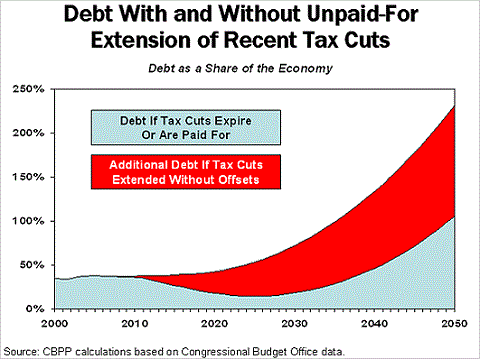
1. The document promises that it will implement or continue massive tax breaks. At the same time, it talks about reducing the deficit. This means, of course, that spending would need to be slashed significantly. The Republicans promise, however, that all cuts to defense, Social Security, veteran's programs, and Medicare are off the table (see page 11), thus eliminating any of the spending areas that really matter to the deficit (these areas account for about 70% of the federal budget). So the Republicans are basically promising to lower taxes, to continue higher spending, and at the same time to cut the deficit and pay down the debt. This just doesn't seem very serious to me, a fantasy. They seem to want us to believe we can have something for nothing.
Update: It seems that, even the Republicans make all the cuts they are promising, their budget deficit would still be higher than what Obama is proposing:
 2. The Republicans are currently voting against some of the very things they are now promising to do. In their economic plan, they promise to "give small businesses a tax deduction" and "repeal small business mandates," while voting against these exact provisions just in the last few days (see here and here). This doesn't seem very serious to me.
3. The Republicans promise to repeal health care reform, while at the same time promising to follow the Democrats in making it illegal for insurance companies to deny you coverage for preexisting conditions. In their plan, however, the Republicans ignore the fact that, if you regulate the insurance industry this way, you need to make sure people buy insurance before they get sick (otherwise they will just buy insurance when they are ill and the system will collapse). They would need to include a further law, as the Democrats did, that everyone needs to buy insurance. They do not; indeed, the requirement to buy insurance is one of the things they angrily promise to repeal. Again, not serious.
4. The Republicans pledge to "end TARP once and for all." TARP, of course, was the so-called bank bailout. Setting aside for a moment that TARP was passed by a Republican president with substantial Republican support (and thus a pledge to reverse their own policy), this makes no sense. As I understand it, TARP isn't paying out much money anymore. In fact, banks are now repaying the money and the government stands to make a profit, at least on the bank portion. TARP is actually a story of bipartisan success. Politicians did an unpopular thing and it turned out to be the correct decision.
5. The chart on page 7 is very misleading and reflects how badly the document misconstrues economics. In this chart, they show that unemployment is worse now than the Obama administration had predicted it would be under the stimulus package. This, they say, is evidence that the stimulus package is a failure. In reality, though, all this shows is that the recession was much worse than predicted. The true comparison is with how bad unemployment would have been without the stimulus package. Most independent economists believe the stimulus has created about 3 million jobs and played a significant role in turning back the recession. It just wasn't big enough to bring back full employment (a fact for which Obama deserves criticism). The chart on page 17 is even worse -- it makes a 3% increase look like Obama is doubling the size of government. The whole discussion of stimulus and budgets seems deceptive to me
Meanwhile, unbelievably, not a word on Afghanistan, Iraq, or Pakistan. Not a word on global warming. Not a word about energy policy or decreasing our dependence on oil. Not a word on the oil spill or drilling policy. Not a word on Israel and Palestine. It is simply not a document that seems very serious. And we need a serious opposition party in this country.